
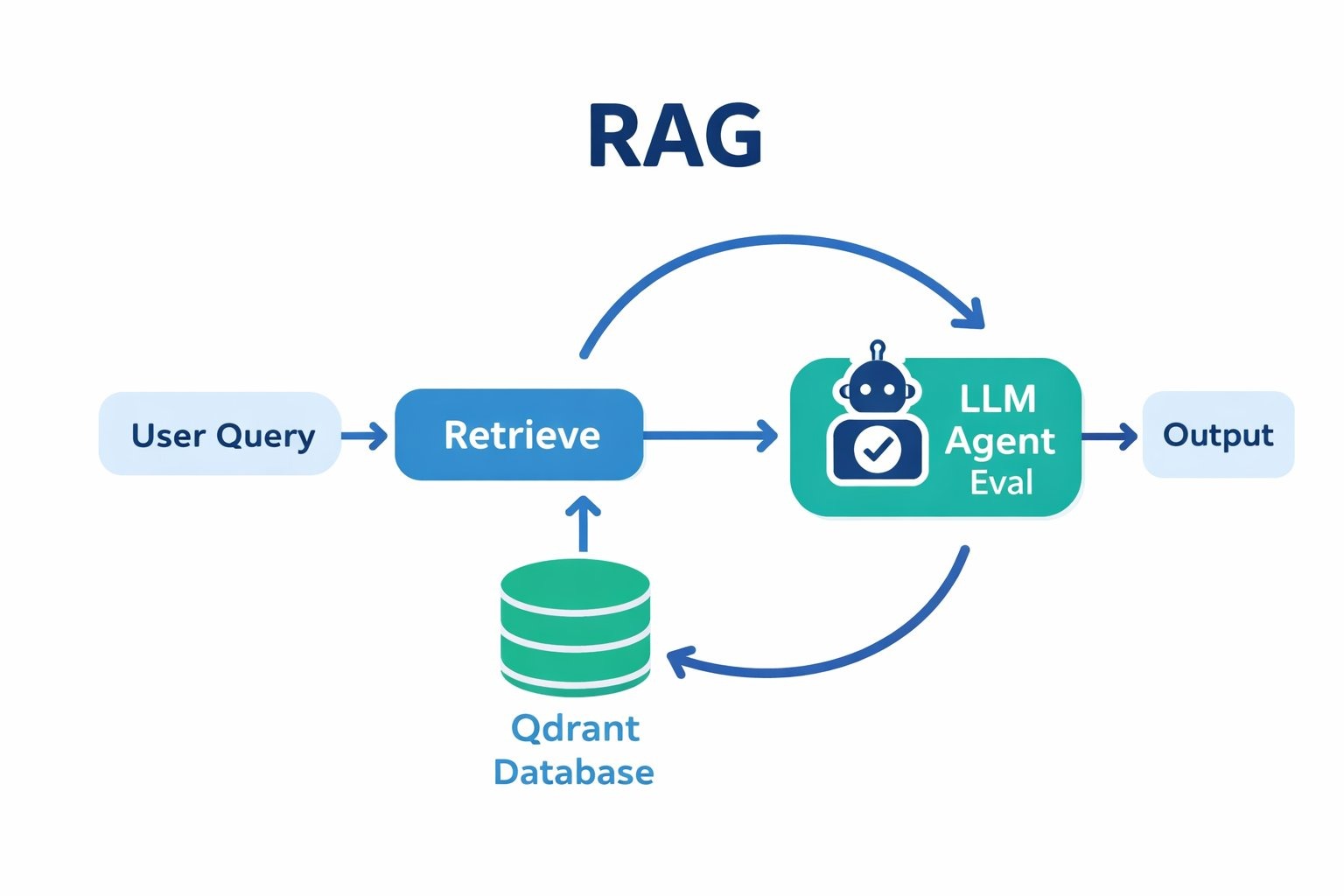
In the rapid evolution of Large Language Model (LLM) architectures, the industry is reaching a consensus: traditional, linear Retrieval-Augmented Generation (RAG) is no longer sufficient for enterprise-grade applications. While standard RAG pipelines provide context, they are fundamentally brittle, unable to recover from poor retrievals or hallucinated queries. The engineering challenge has shifted from simple data retrieval to building Agentic RAG systems—autonomous workflows that can reason, self-correct, and execute complex business logic. By implementing a cyclic graph-based architecture, such as those discussed in Citation-First RAG Systems: Building Safe Enterprise AI, we move beyond passive bots to active agents capable of making executive decisions, such as validating their own sources or triggering external API actions.
The Technical Imperative: Why Agentic RAG?
Standard RAG architectures operate on a 'best effort' retrieval model. If the initial semantic search returns irrelevant documents, the model inevitably produces a low-fidelity or hallucinated response. Agentic RAG solves this by introducing a control loop. Using a state-machine approach, the system can assess the quality of retrieved context, rewrite suboptimal queries, and even decide when it has insufficient data to proceed. This architectural shift is critical for CTOs and VPs of Engineering who require 99.9% reliability in automated customer support, supply chain inventory management, or automated technical documentation agents.
Prerequisites & Modern Tech Stack
To build a production-ready agentic system, a sophisticated stack is required to handle state management and high-concurrency retrieval. Choosing the right foundation is vital, as noted in our guide on Enterprise AI Software Engineering: Claude, GPT & Gemini:
- LangGraph: The orchestration layer for building stateful, multi-actor applications with cyclic computational graphs.
- Qdrant: A high-performance vector database designed for production-scale semantic search and filtering.
- FastAPI: The standard for high-performance, asynchronous Python web APIs to serve the agentic workflows.
- Structured Output Models: LLMs (like GPT-4o or Claude 3.5 Sonnet) capable of strict schema adherence for grading and routing.
Required Competencies
Success requires a deep understanding of graph-based state management, semantic routing, and prompt engineering for structured reasoning. Your team must move away from linear chain thinking and adopt a state-machine mental model where every node in the graph represents a discrete unit of logic.
The Blueprint: Designing the Self-Correcting Graph
The core of an Agentic RAG system is the StateGraph. Unlike a standard chain, a graph allows for loops—if the model is unsatisfied with its own work, it can go back and try again. The typical lifecycle includes:
- Query Analysis: Deciding if the user request requires tool usage or a direct response.
- Retrieval: Fetching high-dimensional vectors from Qdrant.
- Grading: Using a secondary LLM 'grader' to verify the relevance of the retrieved documents.
- Self-Correction: Rewriting the user query if the initial search failed.
- Execution/Action: Generating the final answer or triggering a downstream business process (e.g., updating a database).
Phase-by-Phase Execution
Phase 1: Foundation & Tooling
Begin by defining the MessagesState. This object tracks the conversation history and the internal thought process of the agent. You must define your tools using the
@tool decorator, enabling the LLM to interact with your vector store. For enterprise scale, replace in-memory stores with Qdrant to ensure persistence and low-latency retrieval across millions of document chunks. To see this in action, review our Enterprise Software Case Study regarding 95% faster search times.Phase 2: Core Logic Implementation
Implement the Document Grader. This is a specialized node that assesses whether a retrieved document contains the keywords or semantic meaning necessary to answer the question. By using Pydantic models with
with_structured_output, you can force the LLM to return a binary 'yes' or 'no' score, which drives the graph's conditional edges."Agentic RAG isn't just about finding data; it's about the model knowing when it hasn't found the right data and having the autonomy to try a different approach."
Phase 3: Integration & Robustness
Integrate the Query Rewriter. When the grader returns a 'no,' the graph routes to a node that analyzes the failure and reformulates the question to improve retrieval success. This loop continues until a relevance threshold is met or a max-retry limit is reached. Finally, wrap the entire workflow in a FastAPI endpoint to handle asynchronous streaming of the graph's execution steps.
Performance Engineering and Optimization
To minimize latency in agentic loops, implement speculative execution where possible. For instance, the grader and the generator can sometimes run in parallel if the initial relevance score is high. Furthermore, use LangSmith for tracing. In an agentic system, a single user request might trigger five LLM calls; tracing is the only way to identify bottlenecks or reasoning failures in production.
Production Readiness Standards
Before moving from MVP to production, ensure your system meets these criteria:
- Deterministic Routing: Ensure conditional edges have clear logic to prevent infinite loops.
- State Persistence: Use a checkpointer (like LangGraph's
MemorySaveror a Redis-backed store) to allow agents to resume sessions. - Token Budgeting: Implement hard stops on retries to control costs and prevent 'hallucination loops.'
- Evaluation Frameworks: Use RAGAS or similar frameworks to quantify 'faithfulness' and 'relevancy' metrics.
Future-Proofing: Moving to Multi-Agent Workflows
The architecture described here is the stepping stone to Multi-Agent Systems. Once you have a single RAG agent working, you can introduce specialized agents for different domains—an 'Inventory Agent,' a 'Support Agent,' and a 'Billing Agent'—all managed by a central supervisor graph. This modularity ensures that as your business logic grows, your AI infrastructure remains maintainable and extensible.
Transitioning from basic Q&A bots to Agentic RAG workflows is the defining competitive advantage for modern engineering teams. By leveraging LangGraph and Qdrant, you can build systems that don't just talk, but think, correct, and act. If you are ready to architect your next generation of autonomous AI agents, EnDevSols provides the senior engineering expertise to turn these complex blueprints into scalable production realities. Let's build the future of agentic automation together.