
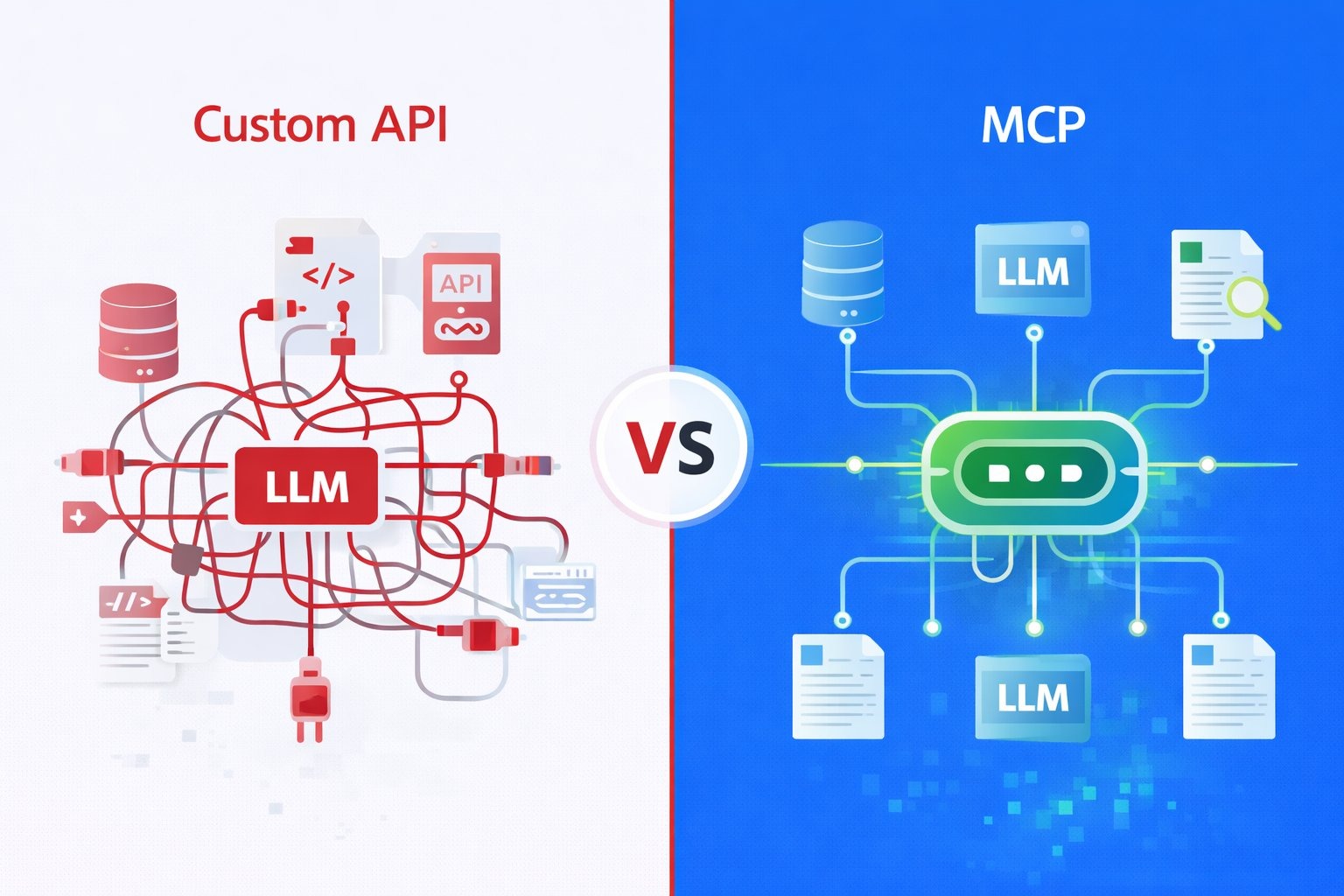
In the current race to operationalize generative AI, the bottleneck is no longer the model itself, but the enterprise AI architecture that connects that model to enterprise reality. As organizations move from experimental chatbots to AI Agents for Enterprise and autonomous agentic workflows, the strategic decision between building bespoke custom integrations or adopting the emerging Model Context Protocol (MCP) has become a defining factor in technical debt and time-to-market. This guide provides a definitive analysis for C-suite leaders to navigate this critical architectural choice, ensuring that your AI investments are both scalable and secure.
The Strategic Landscape: From Fragmentation to Standardization
The enterprise AI landscape is currently mirroring the early days of software development before the advent of the Language Server Protocol (LSP). Organizations are often caught in a cycle of building fragmented, one-off connectors between Large Language Models (LLMs) and their proprietary data stacks—CRMs, ERPs, and internal databases. While these "glue code" solutions work in the short term, they create a maintenance burden that scales linearly with every new tool added.
The Model Context Protocol (MCP) represents a paradigm shift. Inspired by LSP, Model Context Protocol (MCP): Securing the Agentic Future provides a standardized, open protocol for LLM applications to interact with external data and tools. By using a uniform JSON-RPC 2.0 message format, MCP decouples the AI host from the data source, allowing for a composable ecosystem where a single server can serve context to multiple AI clients simultaneously. For the modern enterprise, this isn't just a technical detail; it is a strategy for interoperability.
Custom Integrations: The Cost of Bespoke Control
Building custom API integrations remains the default approach for many engineering teams, offering total control over the implementation. However, the Total Cost of Ownership (TCO) is often underestimated by leadership.
The Pros and Cons of Custom Builds
- Pros: Granular control over proprietary protocols, ability to optimize for ultra-low latency in specialized environments, and no dependency on third-party specification updates.
- Cons: High maintenance overhead, lack of portability across different LLM hosts, and inconsistent security implementations. Each new integration requires a bespoke authorization flow and data mapping exercise.
- TCO Implications: Custom integrations require ongoing developer cycles for every API update or model swap. Over 24 months, the cost of maintaining 10+ custom connectors often exceeds the initial build cost by 300%.
Ideal Use Case: Environments with highly legacy, non-standardized systems that cannot be abstracted, or where milliseconds of latency are the primary success metric.
The Model Context Protocol (MCP): The New Standard
The MCP architecture introduces a stateful, standardized connection between Hosts (the AI application), Clients (connectors), and Servers (the services providing context). It is designed specifically for the era of agentic AI.
Strategic Advantages of MCP
- Unified Interface: MCP standardizes how servers expose Resources (data), Prompts (templated workflows), and Tools (executable functions) to the model.
- Stateful Communication: Unlike stateless REST APIs, MCP supports stateful connections and capability negotiation, allowing the model and the data source to understand each other's limits in real-time.
- Scalability: Once an MCP server is built for a database or tool, it can be instantly utilized by any MCP-compliant AI application, from AI IDEs for Enterprise: Kiro vs Cursor Strategic Guide to customer-facing agents.
Ideal Use Case: Enterprises looking to build a "Single Source of Truth" for AI context that can be reused across multiple departments and LLM providers without rewriting code.
Head-to-Head Strategic Matrix
To assist in decision-making, we have mapped the key differentiators that impact long-term enterprise value:
- Scalability: Custom integrations are Limited (linear growth); MCP is Exponential (composable ecosystem).
- Security Framework: Custom integrations rely on Ad-hoc measures; MCP features Standardized consent and sampling controls.
- Time-to-Value: Custom builds typically take 4-8 weeks per tool; MCP implementations can be prototyped in 7-10 days.
- Vendor Lock-in: Custom integrations often result in High lock-in; MCP provides Low lock-in through open standards.
The Hidden Variables: Security and Trust & Safety
Seasoned leaders know that the biggest risks in AI are not technical, but behavioral. The MCP specification places a significant emphasis on Trust and Safety, which is often overlooked in custom builds. This level of oversight is showcased in our Enterprise Software / Data Privacy & Compliance Case Study. MCP’s architecture requires explicit user consent for Sampling (when the server requests an LLM interaction) and Elicitation (when the server asks the user for more info). This granular control ensures that the AI cannot access sensitive data or execute code without a clear audit trail and human-in-the-loop authorization.
"The power of MCP lies not just in connectivity, but in the protocol-level enforcement of user consent and tool safety. It treats every tool invocation as a privileged action."
Strategic Recommendation
For organizations seeking to lead in the AI space, the recommendation is clear: Adopt a protocol-first mindset. Unless your use case involves extreme proprietary constraints, the Model Context Protocol (MCP) provides the most resilient foundation for agentic AI. It reduces technical debt, enhances security through standardized consent flows, and ensures that your data layer remains model-agnostic.
Executive Action Plan
- Inventory Your Tools: Map the top 5 high-impact data sources (CRM, Jira, Databases) that your AI agents need to access.
- Evaluate Capability: Assess whether your current team has the bandwidth to maintain custom code or if a standardized protocol approach is required for speed.
- Pilot an MCP Solution: Partner with experts to build a working MCP prototype. EnDevSols specializes in this transition, moving from tool-mapping to a functional MCP-powered prototype in just 7 to 10 days.
- Establish Governance: Use MCP’s built-in security principles to define who can authorize tool execution and data sampling.
The choice between MCP and custom integration is the choice between building a silo or building a platform. As the AI ecosystem matures, standardization will win. By choosing the Model Context Protocol now, you are not just connecting tools; you are future-proofing your entire AI strategy. EnDevSols is ready to help you map your enterprise tools to a robust MCP plan and deliver a working prototype in as little as 10 days. Let us accelerate your journey from integration debt to agentic excellence.