WhatsApp AI Maintenance Dispatcher: 85% Faster Response for a Multi-Family Housing Portfolio
How a property management team automated WhatsApp maintenance intake with AI triage, cutting response time by 85% and reducing secondary damage incidents by ~40% — measured over 6 months of production.
The Challenge
The client manages a massive multi-family housing portfolio where maintenance coordination was a primary operational bottleneck. With thousands of tenants across multiple regions, communication was fragmented and highly manual.
Core Problem
The Business Problem
Maintenance operations for this national residential portfolio were historically managed through a fragmented combination of WhatsApp messages, SMS, and ad-hoc phone calls. For a team of property managers overseeing thousands of units, the daily reality was a constant stream of unstructured data. Tenants would frequently send vague messages like "the sink is broken" or "there is a leak in the hallway" without providing a unit number, a photo of the damage, or an assessment of the severity. This lack of standardized intake created a massive operational bottleneck.
Each incoming request required a manual follow-up from a staff member to gather basic context. Because maintenance issues often occur outside of standard business hours, these messages would sit in a WhatsApp inbox until the following morning. During peak periods or seasonal shifts (such as the first freeze of winter), the sheer volume of unstructured messages made it impossible for the operations team to prioritize effectively. This resulted in a "first-come, first-served" approach rather than a priority-based triage, leading to critical failures being buried under routine cosmetic requests.
The friction extended to the vendor side as well. Without clear documentation or photos, vendors were often dispatched to sites with the wrong equipment or parts, leading to multiple site visits for a single repair. The internal operational logs showed that approximately 22% of all maintenance calls required at least two follow-up interactions just to define the scope of work before a technician could even be scheduled.
Why Standard Tools Failed
The client had previously attempted to use off-the-shelf property management software and generic ticketing portals. However, tenant adoption of these portals remained below 20%. Tenants preferred the low friction of WhatsApp, and forcing them into a separate app or web portal led to them bypassing the system entirely and calling the emergency line for non-emergencies. Generic chatbots were also trialed but failed because they lacked the technical logic to distinguish between a minor faucet drip and a high-pressure pipe burst, often providing the same generic response to both scenarios.
Spreadsheet-based tracking was equally ineffective, as it couldn't handle real-time updates or media attachments. The gap was clear: the client needed a solution that met tenants where they already were (WhatsApp) but enforced the data integrity of a professional enterprise resource planning (ERP) system.
The Operational Failure Points
Vague Intake Descriptions: Maintenance requests arrived as voice notes or short text strings with no specific location data, making triage impossible without manual follow-up calls.
Asynchronous Delay: Critical issues reported at 2:00 AM were not seen by staff until 9:00 AM, allowing minor leaks to escalate into major floods over a 7-hour window.
Media Fragmentation: Photos of damage were rarely provided upfront, and when they were, they were not linked to the specific ticket in the database, causing confusion for dispatchers.
Duplicate Submissions: Multiple tenants in the same building would report the same common-area issue, leading to three different vendors being contacted for one repair.
Manual Data Entry Triage: Staff spent an average of 4 minutes per ticket simply transcribing WhatsApp data into the central management system.
To solve this, an AI-native, custom-built system was required. It needed to provide the flexibility of natural language conversation while strictly enforcing business rules for data collection, ensuring no ticket was created without the necessary evidence for triage.
The cost of operational inertia was substantial. Based on internal operational logs and historical financial data over a 12-month period, the client identified that delayed identification of high-priority failures resulted in avoidable remediation costs exceeding $250,000 annually. For example, a slow-leak report that was miscategorized as a routine repair frequently escalated into a structural mold issue or a multi-unit flood, increasing the repair bill by 10x.
Beyond the direct financial hit, the firm faced a measurable uptick in tenant churn. Based on move-out surveys, "slow maintenance response" was cited as a primary factor in 35% of lease non-renewals. Staff burnout was also a critical risk; property managers were effectively on-call 24/7 to handle triage, leading to high turnover in the operations department. The client realized that continuing with manual intake would eventually lead to a reputation crisis and a decline in asset value. They decided to move to a custom AI solution because off-the-shelf tools could not provide the specific logic required to automate triage while maintaining the user-friendly interface of a chat application.
The Solution
What We Built
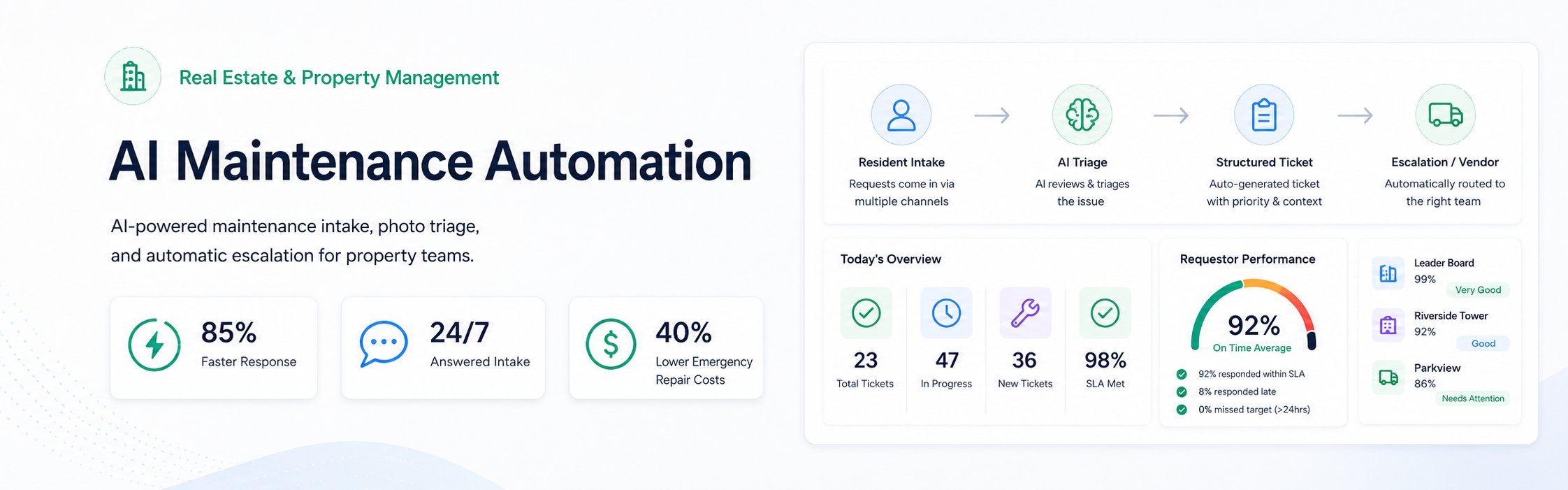
EnDevSols developed a custom AI Maintenance Dispatcher that functions as an intelligent layer between the tenant's WhatsApp app and the property manager's dashboard. Instead of a human receiving a messy message, the AI greets the tenant, asks clarifying questions to satisfy data requirements, and analyzes uploaded photos in real-time. The system determines if the issue is an emergency based on predefined criteria and either alerts the on-call team immediately or logs a standard ticket for the next business day.
How It Works — Step by Step
- The tenant sends a message or photo to the property's dedicated WhatsApp number handled via the Meta Cloud API.
- The system uses a Large Language Model (LLM) to identify the core intent (e.g., plumbing, electrical, HVAC) and the specific unit involved.
- If details are missing, the AI follows a deterministic state-machine logic to request specific information, such as a photo of the leak or the exact room location.
- The AI analyzes the tenant's description and any uploaded media to assign an urgency score from 1 (Cosmetic) to 5 (Emergency).
- The system checks the property database for duplicate reports in the same building to prevent redundant vendor dispatches.
- A structured ticket is automatically generated in the client's database, including a summary of the issue, the urgency score, and a direct link to the media.
- For high-urgency tickets, the system triggers an automated phone escalation to the on-call maintenance supervisor.
Integration with Existing Systems
The system was built to integrate directly with the client's existing PostgreSQL database and their vendor management portal via a custom FastAPI orchestration layer. This ensured that property managers didn't have to learn a new tool; they simply saw higher-quality, pre-vetted tickets appearing in their existing workflow. By connecting to the Meta WhatsApp Cloud API, we maintained the communication channel tenants preferred while gaining the programmatic control needed for enterprise-grade automation.
Tech Stack
Key Results
Measured Impact
- 85% reduction in average maintenance response time, measured over 6 months of production operation
- Automated intake handling for approximately 98% of standard request types, with human review for complex cases, measured across 90 days post-launch
- Approximately 40% reduction in secondary property damage incidents, compared against the prior 12-month baseline, tracked via internal maintenance logs
Values & Impact
- Property managers no longer handle after-hours emergency triage calls; the system routes and escalates automatically based on urgency.
- Vendors receive standardized, photo-documented work orders, leading to a significant reduction in 'dry runs' and incorrect parts ordering.
- Tenant satisfaction scores improved due to sub-30-second acknowledgment of all maintenance reports, regardless of the time of day.
- Eliminated manual data entry for maintenance intake, freeing up approximately 30 hours of staff time per week for high-value resident relations.
- Improved data quality for long-term asset management by ensuring 100% of tickets have categorized issue types and associated media.
- Reduced staff burnout and turnover by removing the burden of 24/7 manual monitoring of the WhatsApp intake channel.
- Enhanced reporting capabilities allow the VP of Operations to identify recurring appliance failures across the entire portfolio in real-time.
- Mitigated liability risks by maintaining a complete, time-stamped audit trail of every maintenance interaction and response.
"EnDevSols transformed our most chaotic operational pain point into a streamlined, automated engine. We no longer guess which leaks are emergencies; the AI tells us immediately, and our tenants love the instant response."
VP of Operations, National Residential Portfolio
Core AI Services Used in Projects Like This
Need a Similar AI System?
Book a free 30-minute discovery call. We'll review your system or project idea and tell you exactly what it takes to build production-ready AI.