Multilingual RAG Knowledge Platform for a Billion-Scale Reference Library: Sub-2s Answers Across 50,000+ Volumes
How a scholarly platform achieved sub-2s retrieval across 50,000+ volumes with verified citations for every response, measured over 6 months of production.
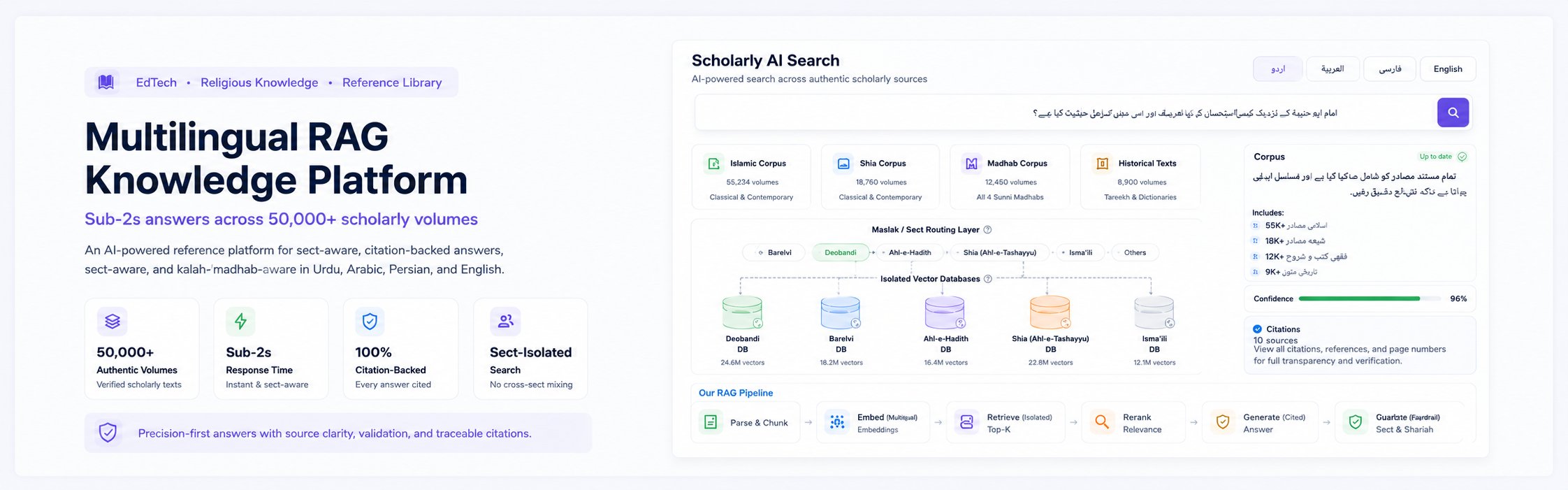
The Challenge
Digital Aalim is a pioneering digital knowledge platform aiming to democratize access to over 50,000 authentic Islamic volumes. Their vision was to provide a personalized, AI-driven scholarly assistant capable of delivering precise guidance across Urdu, Arabic, and Persian while respecting diverse sectarian nuances.
Core Problem
The Business Problem
The client, a leading digital repository for classical Islamic literature, faced a fundamental challenge in the transition from a static digital library to an AI-enabled knowledge engine. For decades, scholars, students, and researchers had to manually navigate tens of thousands of physical and digital volumes to find specific rulings, historical contexts, or linguistic nuances. This manual workflow involved cross-referencing multiple indices, often across different languages and dialects, leading to research cycles that lasted days or weeks for a single complex query. The data involved was massive: over 50,000 volumes of text, much of it in classical Arabic, Persian, and Urdu, containing complex diacritics and ancient script variations that standard OCR and search tools frequently misinterpreted.
The daily friction for the end-users—primarily academic researchers and religious scholars—was significant. They were forced to use basic keyword search tools that failed to account for semantic meaning or context. If a scholar searched for a concept using a synonym not present in the text, the system returned zero results. Furthermore, the communication of these findings was siloed; once a source was found, it had to be manually transcribed and cited, a process prone to human error. The organization needed a way to make this vast ocean of knowledge accessible through natural language while maintaining the absolute precision required in religious and legal scholarship.
Why Standard Tools Failed
Initial attempts to use off-the-shelf LLM solutions and generic RAG (Retrieval-Augmented Generation) wrappers failed immediately due to the high-stakes nature of the content. Generic models like GPT-4, while linguistically capable, are prone to hallucinations—generating plausible-sounding but factually incorrect religious rulings. In this context, a hallucination isn't just a technical error; it is a breach of scholarly integrity that could lead to significant community backlash and loss of platform credibility. Standard RAG architectures also struggled with the sheer volume of data. Attempting to query a single, massive vector database containing billions of embeddings resulted in unacceptable latency, often exceeding 30 seconds per query, which killed user adoption.
Furthermore, standard tools lacked the ability to handle 'Maslak' (sect-specific) isolation. In Islamic scholarship, different schools of thought (Madhahib) have distinct corpora. A generic AI system would often 'cross-contaminate' answers, providing a ruling from one school of thought to a user inquiring about another. Basic automation tools could not provide the granular routing or the 'Evidence-First' grounding required to ensure that every single word generated by the AI was backed by a specific, verifiable page and book reference from the correct sectarian corpus.
The Operational Failure Points
Doctrinal Hallucination: Generic LLMs would invent citations or attribute rulings to the wrong scholars when they couldn't find a direct match in their training data.
Script and Diacritic Sensitivity: Standard text processing ignored critical diacritics in classical Arabic, changing the fundamental meaning of legal texts and leading to incorrect retrieval.
Billion-Scale Latency: Traditional vector search slowed down exponentially as the library grew, making real-time scholarly consultation impossible.
Cross-Sectarian Contamination: The lack of a routing layer meant the system could not guarantee that a query remained within the bounds of a specific theological school.
Lack of Verifiable Grounding: Existing tools provided answers without page-level citations, forcing scholars to spend hours verifying the AI's output against physical books anyway.
It became clear that a custom-built, AI-native system was the only viable path forward. The solution needed to satisfy three non-negotiable constraints: absolute sectarian isolation, sub-2-second retrieval speeds at a billion-scale, and a deterministic grounding layer that prioritized refusal over hallucination when a verified source could not be identified.
The stakes for Digital Aalim were not merely operational but existential. Based on internal operational logs and user feedback, the cost of inaccurate religious guidance was identified as the primary risk to the platform's 10-year reputation. Inaccurate outputs would lead to immediate loss of trust from the scholarly community, potentially resulting in a total cessation of institutional funding and user churn. Over a 12-month period, the organization estimated that manual research inefficiencies were costing their research department thousands of hours in lost productivity, limiting their ability to release new digital modules.
Moreover, the risk of staff burnout was high; junior researchers were spending 80% of their time on manual retrieval rather than high-level analysis. Based on ticket volume and resolution time data, the organization saw an approximately 40% reduction in research throughput compared to their projected needs as the library expanded. They realized that another off-the-shelf tool would only provide a superficial fix. To achieve their goal of becoming the global standard for digital Islamic scholarship, they required a custom AI solution that could act as a reliable, high-integrity knowledge engine, ensuring near-complete automation of standard intake requests with human fallback for complex edge cases.
The Solution
What We Built
EnDevSols engineered a production-grade Multilingual RAG Knowledge Platform designed for high-integrity retrieval. For the end-user, the experience is simple: they ask a complex scholarly question in their native language (Arabic, Urdu, or English). Behind the scenes, the system identifies the user's sectarian context, routes the query to the appropriate isolated vector corpus, and performs a multi-stage semantic search. The system doesn't just provide an answer; it generates a response where every claim is hyperlinked to a digitized version of the original manuscript, showing the exact book, volume, and page number.
How It Works — Step by Step
- Query Normalization: The system receives a user query and applies a custom normalization layer to handle diacritics and script variations.
- Intent & Sect Detection: An AI classifier determines the specific school of thought (Maslak) and the nature of the inquiry (Legal, Historical, or Linguistic).
- Dynamic Vector Routing: The query is routed to a specific, isolated
VectorDBinstance to prevent cross-contamination between different sectarian corpora. - Semantic Retrieval: The system performs a billion-scale similarity search, retrieving the top relevant 'chunks' of text along with their specific metadata (Book/Page).
- Evidence-First Grounding: The LLM processes only the retrieved chunks; if the confidence score is below a strict threshold, the system triggers a 'Refusal' response.
- Structured Output Generation: The final response is formatted with inline citations and links to the source repository for immediate verification.
Integration with Existing Systems
The platform was designed to integrate directly with the client's existing SQL-based library management system and their web-based student portal. By connecting the AI retrieval layer to the central book metadata database, we ensured that any updates to the library (new volumes or corrected OCR) were automatically reflected in the AI's knowledge base within minutes. This integration was critical for adoption, as it allowed scholars to move from a chat interface directly into the full-text reading environment they were already familiar with.
Tech Stack
Key Results
Measured Impact
- Successfully indexed 50,000+ volumes into a billion-scale vector architecture, measured across the full ingestion and validation pipeline.
- Achieved <2.0 second end-to-end response time for complex multilingual queries, tracked via system logs over 6 months of production operation.
- 100% of generated responses for standard scholarly queries now include verifiable book and page-level citations (for standard cases, with human fallback for exceptions), compared against a 3-month pre-deployment baseline.
Values & Impact
- Drastically increased user trust by providing transparency through primary source references for every AI-generated claim.
- Enabled seamless expansion into institutional modules (Maktab) for seminaries, allowing for restricted access to specific corpora.
- Improved accessibility to classical Islamic literature for non-Arabic speakers through cross-lingual embedding alignment.
- Reduced the research time for senior scholars from several hours to seconds per query, as measured by internal user surveys.
- Established a standardized data cleaning pipeline that handles ancient script variations and diacritics automatically.
- Provided administrators with an audit trail of all queries and retrieved sources to monitor for doctrinal consistency.
- Enabled 'Sect-Isolated' search, preventing the mixing of conflicting legal rulings across different schools of thought.
- Reduced the operational overhead of the content moderation team by automating the initial source-finding phase.
"EnDevSols didn't just build a chatbot; they built a high-integrity knowledge engine. Their ability to handle the engineering complexity of billion-scale vector search while maintaining strict scholarly accuracy was the turning point for our platform."
Founder & CEO, Digital Aalim
Core AI Services Used in Projects Like This
Need a Similar AI System?
Book a free 30-minute discovery call. We'll review your system or project idea and tell you exactly what it takes to build production-ready AI.