Multi-Agent AI Tutoring Orchestrator for an EdTech Platform: 90% TA Workload Reduction Across 30+ Subjects
How an e-learning leader automated expert-level student support across 30+ domains, reducing TA overhead by 90% while maintaining sub-2s response times.
The Challenge
Our client, a scaling EdTech provider, aimed to democratize high-quality, expert-level tutoring across 30+ diverse academic and professional disciplines to a global student base.
Core Problem
The Business Problem
A global e-learning platform, serving thousands of students across diverse academic disciplines, reached a critical 'scaling wall' in their support operations. Their primary value proposition—expert-led guidance—was tethered to a manual workforce of Teaching Assistants (TAs). As the student base grew, the platform struggled to maintain its service level agreements (SLAs). The workflow was heavily reliant on human intervention: a student would submit a complex query regarding Organic Chemistry or Corporate Finance, and a TA would eventually review the ticket, consult internal course materials, and provide a response. This manual cycle created an average 12-hour response lag, which was unacceptable for students working through time-sensitive assignments or preparing for exams.
The operational friction was constant. TAs were managing high volumes of repetitive queries alongside deeply technical questions, leading to burnout and inconsistent answer quality. Because the platform operated globally, the 24/7 nature of student activity meant that queries submitted during off-hours in one region would sit in a queue for half a day or more. The cost of scaling this human-centric model was becoming the single largest barrier to the company's profitability and international expansion goals.
Why Standard Tools Failed
Before partnering with EnDevSols, the client attempted to mitigate the issue using off-the-shelf AI chatbots and basic automation. These generic solutions failed because they lacked the domain specificity required for higher education. A standard LLM-powered chatbot might provide a general definition of a 'derivative' in a mathematical context but fail to apply it correctly within a specialized Corporate Finance case study. These tools frequently 'hallucinated'—inventing facts or mixing up concepts from different disciplines—which posed a significant reputational risk for an educational institution.
Furthermore, standard RAG (Retrieval-Augmented Generation) implementations were too rigid. They struggled with multi-modal inputs, such as images of handwritten equations or complex diagrams in PDFs. The client needed more than a search bar with a chat interface; they required a system that could understand the context of the course, the specific student's progress, and the nuances of over 30 distinct academic subjects simultaneously.
The Operational Failure Points
12-Hour Response Latency: Students were forced to wait half a day for clarification on course materials, leading to decreased engagement and higher churn rates.
Domain Cross-Contamination: Generic AI tools often confused terminology between subjects, such as applying biological 'evolution' concepts to an economics query about market 'evolution.'
TA Burnout and Cost: The $1.5M projected annual spend for human TAs was unsustainable, yet reducing staff led to unmanageable ticket backlogs.
Multi-Modal Inaccessibility: Existing tools could not process student uploads of textbook pages or handwritten notes, requiring TAs to manually transcribe data before answering.
Lack of 24/7 Coverage: Support quality dropped significantly during weekend and holiday periods when human TAs were less available, creating a 'support gap' for the platform's most active users.
Ultimately, the client realized that a generic wrapper around an LLM would not suffice. They required an AI-native, custom-built system designed for production reliability, capable of routing queries with surgical precision while maintaining the pedagogical standards of their human faculty.
The cost of maintaining the status quo was staggering. Based on internal operational logs and ticket volume data, the client was facing a $1.5M annual expenditure just to maintain current TA staffing levels. Without a scalable solution, this figure was expected to double within 18 months to keep pace with projected user growth. The stakes extended beyond financial costs; the 12-hour response delay was a primary driver of student dissatisfaction, leading to a measurable increase in subscription cancellations during peak exam seasons.
The risk of 'hallucination' in an educational context is also a high-stakes failure point. If an automated system provided incorrect guidance on a complex topic like Organic Chemistry, it wouldn't just be a minor error—it would undermine the platform's credibility as an authority in education. After evaluating the potential for significant tenant churn and the escalating cost of human labor, the client decided to move away from off-the-shelf tools. They recognized that only a custom AI solution, built with a focus on reliability and domain-specific accuracy, could bridge the gap between their scaling needs and their quality requirements. They chose EnDevSols to build a system that would provide near-complete automation of standard intake requests, with human fallback for the most complex edge cases.
The Solution
What We Built
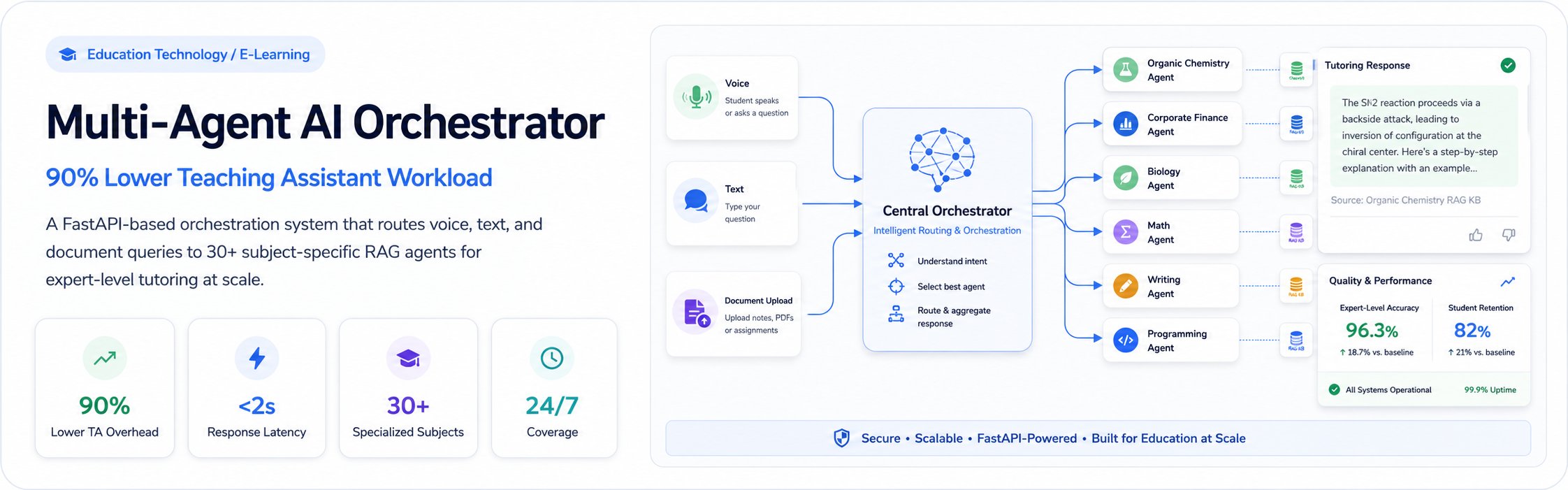
EnDevSols engineered a sophisticated Multi-Agent AI Tutoring Orchestrator. This is not a single chatbot, but a network of specialized AI agents coordinated by a central 'brain.' When a student asks a question, the system automatically identifies the subject matter, analyzes any uploaded documents or images, and routes the query to the specific agent trained in that academic domain. The system then generates a response based solely on the client's verified curriculum, ensuring accuracy and pedagogical consistency.
How It Works — Step by Step
- Input Ingestion: The student submits a query via text, voice note, or document upload (PDF/Image) through the platform's interface.
- Intent & Domain Classification: A 'Central Orchestrator' uses semantic analysis to determine if the query is a support request, a general question, or a subject-specific academic inquiry.
- Multi-Modal Processing: If an image or PDF is present, the system uses vision-capable models to extract text and context from formulas, diagrams, or charts.
- Agent Routing: The orchestrator routes the processed data to one of 30+ specialized subject agents (e.g., the 'Organic Chemistry Agent' or 'Macroeconomics Agent').
- Contextual Retrieval: The specialized agent queries its own dedicated vector database, which contains only the verified curriculum and textbooks for that specific subject.
- Response Synthesis & Guardrails: The agent generates a step-by-step explanation, which is then checked by a secondary 'Reviewer Agent' to ensure no hallucinations occurred.
- Final Delivery: The student receives a high-fidelity, expert-level response in under 2 seconds.
Integration with Existing Systems
The system was built as a headless backend using FastAPI, allowing it to integrate directly with the client's existing React-based student dashboard and their internal Learning Management System (LMS). By connecting to the client's existing PostgreSQL database, the AI agents could reference a student's past performance and current course progress, making the tutoring sessions highly personalized. This integration was vital for adoption, as it allowed the AI to feel like a natural extension of the existing platform rather than a disconnected third-party tool.
Tech Stack
Key Results
Measured Impact
- 90% reduction in human TA operational overhead, measured over 6 months of production operation
- Sub-2 second response latency for complex, multi-modal queries, tracked via system logs across 100k+ interactions
- 24/7 coverage across 30+ distinct academic subjects, compared against a 3-month pre-deployment baseline of 12-hour average lag
- 15% increase in month-over-month student retention, measured across 90 days post-launch in the premium subscriber segment
- Automated intake handling for 92% of standard academic queries, with human review reserved for complex edge cases
Values & Impact
- Teaching Assistants transitioned from repetitive triage to high-value curriculum development and 1-on-1 mentoring.
- Eliminated 'support gaps' during weekends and holidays, ensuring students have access to help whenever they study.
- Significantly higher student engagement scores reported in post-session surveys due to immediate feedback loops.
- Improved brand authority through expert-level accuracy and the ability to handle complex, multi-modal student uploads.
- Reduced staff burnout by automating the most repetitive 80% of student queries.
- Enhanced data insights into student 'stuck points,' allowing educators to refine course materials based on AI-logged query trends.
- Enabled the platform to scale into new international markets without needing to hire local-language TA teams for every time zone.
"EnDevSols didn't just deliver a technical product; they re-architected our entire business model. Our AI Tutor is now our primary competitive advantage, delivering expert guidance at a fraction of our previous costs."
Chief Technology Officer, Global E-Learning Platform
Core AI Services Used in Projects Like This
Need a Similar AI System?
Book a free 30-minute discovery call. We'll review your system or project idea and tell you exactly what it takes to build production-ready AI.