
Computer Vision AI in 2026: From Discriminative Detection to Multimodal Reasoning
In the 2026 technological landscape, artificial intelligence (AI) has transcended the era of mere pattern matching. Computer Vision (CV) once a field confined to simple object labeling—has evolved into a sophisticated discipline of visual intelligence. Today, we don't just train machines to "see"; we architect systems that perceive, reason, and act within complex spatial environments. This guide explores the transition from traditional CNN-based architectures to the state-of-the-art (SOTA) multimodal systems currently driving global enterprise ROI.
The Mechanics of Vision: Foundational Pipelines
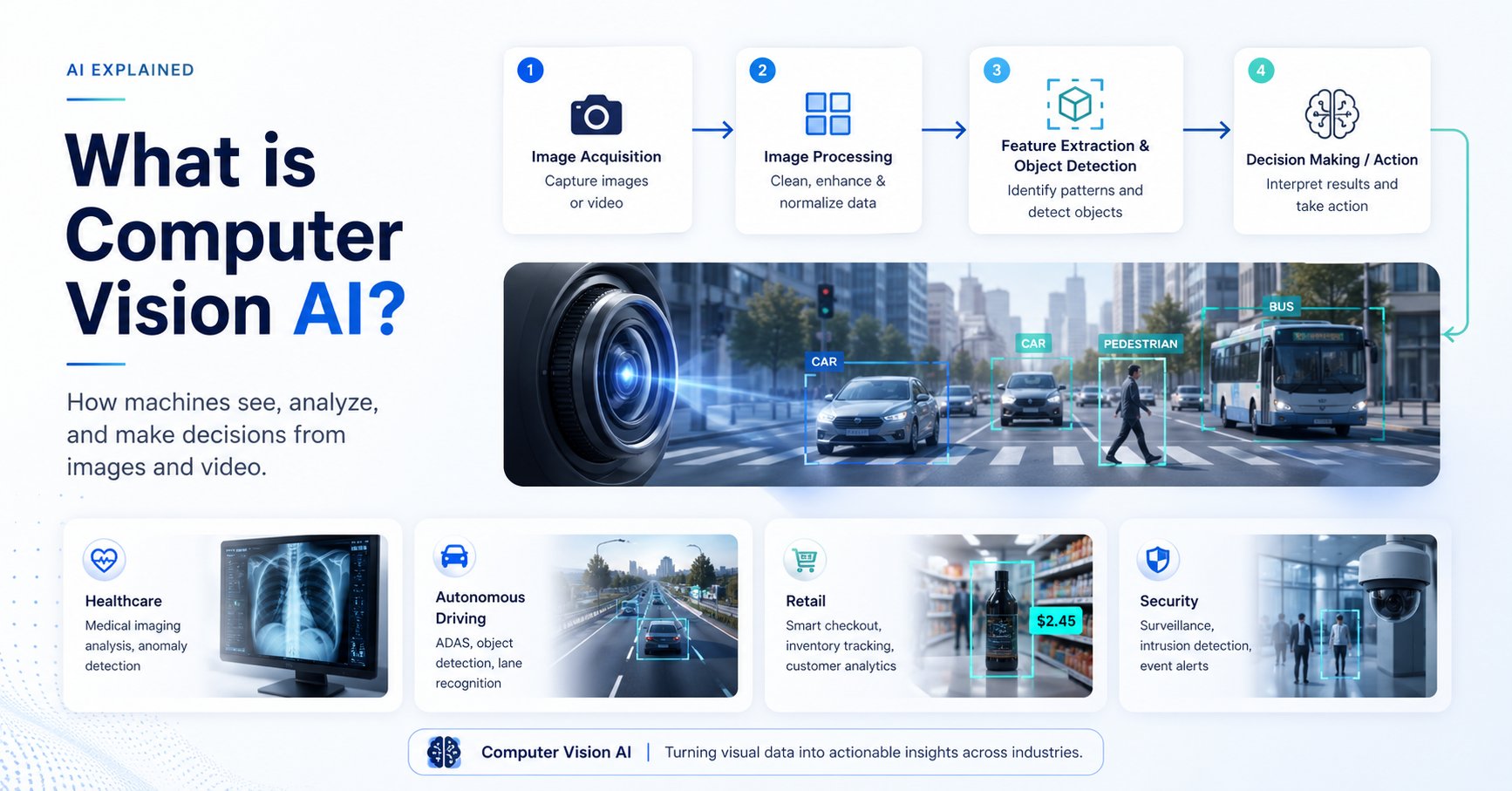
Modern Computer Vision remains grounded in a robust pipeline of data transformation, though the complexity of each stage has increased exponentially with the advent of high-resolution sensors and real-time requirements.
- High-Fidelity Acquisition: Capture of raw visual data via hyperspectral sensors, LiDAR, or standard RGB streams. In 2026, the emphasis is on maintaining high dynamic range (HDR) for low-light industrial environments.
- Neural Pre-processing: Moving beyond simple brightness/contrast adjustments, we now use latent-space denoising and super-resolution to "reconstruct" missing data in degraded frames before they reach the inference engine.
- SOTA Feature Extraction: While Convolutional Neural Networks (CNNs) remain the workhorse for localized feature detection, modern systems often employ Vision Transformers (ViTs) to capture global context and long-range dependencies within an image.
The SOTA Shift: From YOLO to Multimodal Foundation Models
For years, real-time vision was dominated by discriminative models like YOLO (You Only Look Once) and ResNet. These models were exceptional at identifying what is in a frame, but they lacked the ability to explain why or how things relate to each other. In 2026, we have transitioned to Large Vision-Language Models (LVLMs) like Gemini 3.1 and GPT-5.5.
These Multimodal Foundation Models represent a paradigm shift:
- Visual Reasoning: Unlike traditional detectors, an LVLM can "reason" about a scene. Instead of just identifying a "forklift," the model can detect that the "forklift is operating in a restricted safety zone with high-velocity personnel nearby."
- Zero-Shot Capabilities: Traditional CV required thousands of labeled images for a new object. Today, our multimodal systems can recognize novel components or anomalies through natural language descriptions alone, drastically reducing deployment timelines.
Edge AI & Local-First Vision: The 2026 Infrastructure Standard
The "Cloud-First" era of AI has officially ended for vision-intensive applications. High-latency pipelines are no longer acceptable for industrial robotics, surgical assistants, or autonomous security. 2026 is the year of Local-First Vision.
At EnDevSols, we architect Edge AI solutions that process inference directly on specialized Neural Processing Units (NPUs) or TPUs. This "Edge-Orchestration" strategy offers three critical advantages:
- Sub-millisecond Latency: Critical for real-time collision avoidance and automated quality control on high-speed manufacturing lines.
- Data Sovereignty: Visual streams never leave the local network, satisfying strict HIPAA, GDPR, and enterprise privacy protocols.
- Bandwidth Efficiency: Only processed "Insights" (metadata) are sent to the cloud, rather than massive raw video streams, reducing infrastructure costs by up to 70%.
Synthetic Data & Generative Simulation: Solving the ROI Gap
One of the greatest barriers to enterprise AI is the "Data Scarcity" problem. High-quality, human-labeled datasets are expensive and slow to produce. EnDevSols bridges this gap using Generative Synthetic Data.
By using Generative AI pipelines (Diffusion models and 3D NeRFs), we create photorealistic simulations of rare edge cases—such as rare industrial equipment failures or complex surgical anomalies. This allows us to train models in "Perfect Information" environments, ensuring that when the system reaches production, it is already optimized for every conceivable scenario. This strategy ensures a significantly faster ROI by eliminating months of manual data collection.
High-Impact Enterprise Applications
Healthcare & Clinical Vision
Beyond simple diagnostics, 2026 vision systems provide Real-Time Intraoperative Guidance. We develop medical vision pipelines that overlay critical telemetry onto surgical feeds, identifying nerve bundles and vascular structures with sub-millimeter precision. These Deep Learning models are now used for automated clinical note generation based on visual patient monitoring, reducing the administrative burden on healthcare providers.
Industry 4.0 & Autonomous Logistics
In the automotive and logistics sectors, Computer Vision is the nervous system of the "Dark Warehouse." Our systems enable fully autonomous forklifts and AMRs (Autonomous Mobile Robots) to navigate dynamic environments with zero human intervention. By integrating CV with Behavioral AI, these systems can predict human movement patterns to proactively prevent safety incidents before they occur.
Intelligent Security & Crowd Analytics
Modern security has moved past simple motion detection. Using SOTA Anomaly Detection, our systems can identify suspicious behavioral patterns in crowded public spaces or high-security facilities, alerting personnel to potential threats based on intent analysis rather than just movement.
Ready to Deploy Production-Grade Vision AI?
From real-time object detection to multimodal reasoning systems, EnDevSols engineers AI that scales with your business workflows.
Trusted by companies in 30+ countries. 24h Response Time.