
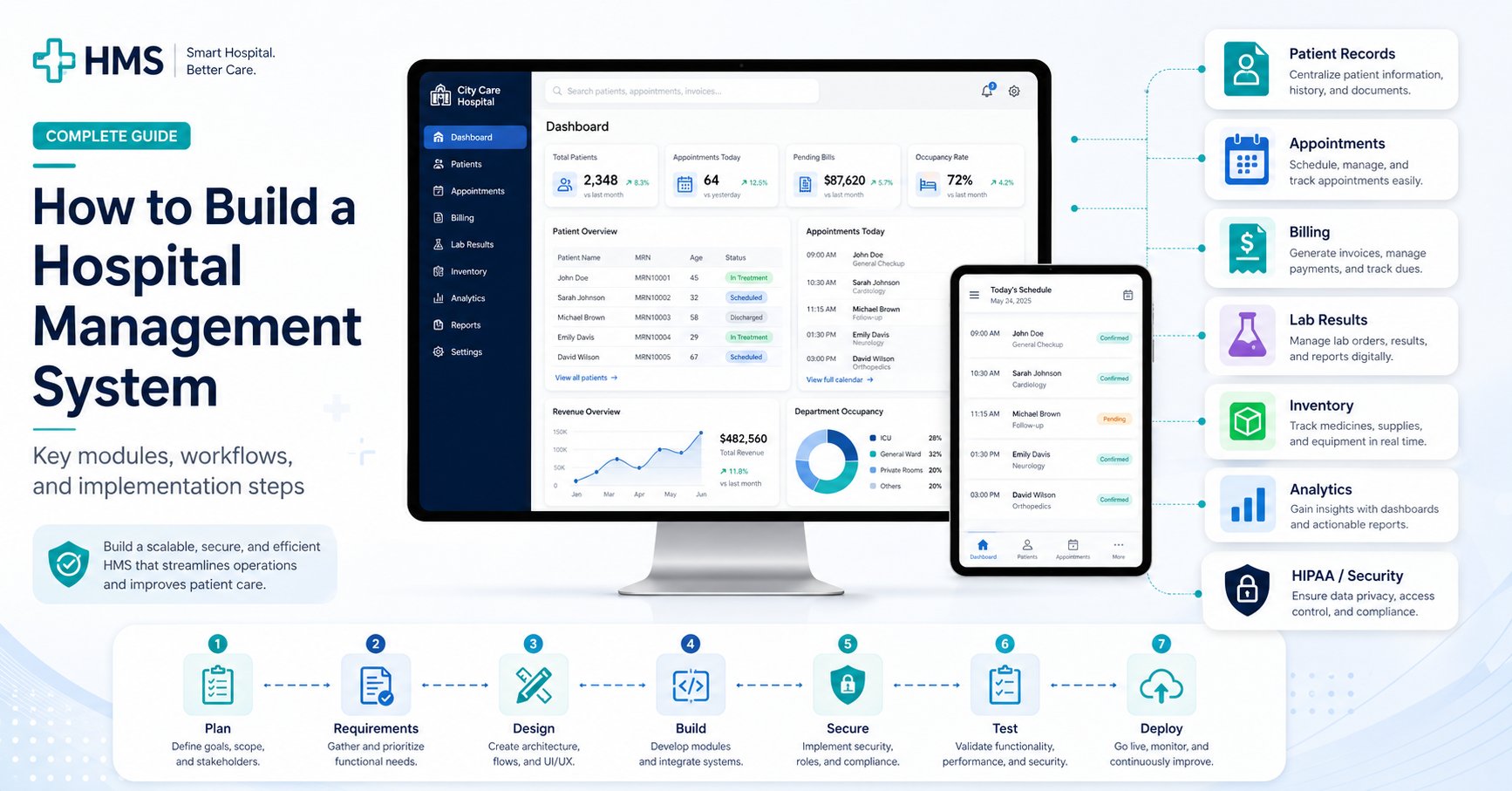
Building a modern Hospital Management System (HMS) is no longer only about digitizing patient records or replacing paper-based workflows. Hospitals, clinics, diagnostic centers, and healthcare startups now need secure, scalable, and integration-ready platforms that can manage patients, doctors, appointments, billing, inventory, laboratory workflows, pharmacy operations, analytics, mobile access, and AI-assisted automation from one centralized system.
If you are searching for how to develop a hospital management system, this guide explains the complete process from business requirements and core HMS features to technical architecture, security, compliance, cost estimation, AI opportunities, and the right development approach for healthcare organizations.
At EnDevSols healthcare software development, we help businesses design and build secure digital healthcare platforms, custom medical software, AI-powered healthcare systems, web applications, mobile apps, and scalable cloud-based solutions tailored to real operational needs.
What is a Hospital Management System?
A Hospital Management System is a healthcare software platform that centralizes and automates hospital operations. It connects administrative, clinical, financial, and operational workflows so that hospitals can manage patient information, appointments, doctor schedules, medical records, billing, lab results, prescriptions, pharmacy stock, inventory, and reporting from one connected platform.
A well-developed HMS improves operational visibility, reduces manual errors, speeds up patient service, supports better decision-making, and creates a reliable foundation for future healthcare automation. For larger healthcare organizations, the system may also need to integrate with EHR/EMR platforms, FHIR APIs, insurance systems, laboratory devices, radiology systems, payment gateways, mobile apps, and AI-powered support tools.
Why Hospitals Need a Custom HMS Instead of Generic Software
Ready-made hospital software can work for basic use cases, but many healthcare organizations quickly outgrow generic platforms. Every hospital has its own departments, approval flows, billing rules, patient journey, reporting needs, staff roles, compliance requirements, and integration challenges.
A custom software development approach is usually better when the hospital needs unique workflows, multi-branch operations, patient portals, custom billing logic, AI automation, mobile access, advanced analytics, or integration with existing healthcare systems.
- Custom workflows: Build appointment, admission, discharge, billing, and pharmacy processes around the hospital’s actual operations.
- Better scalability: Start with core modules and expand into labs, pharmacy, telemedicine, patient apps, analytics, and AI modules.
- Stronger integration: Connect the HMS with payment systems, insurance platforms, EHR/EMR tools, FHIR APIs, laboratory systems, and third-party services.
- Improved ownership: Control the roadmap, data model, user roles, reporting dashboards, and future product direction.
Core Modules of a Hospital Management System
The best HMS platforms are modular. Instead of building everything as one complex block, each department and workflow should be developed as a connected module. This makes the system easier to maintain, scale, test, and improve over time.
1. Patient Registration and Profile Management
Patient registration is the foundation of an HMS. It should allow staff to create patient profiles, store demographic information, manage patient IDs, record visit history, upload documents, and maintain medical notes in a structured way.
- Patient demographics and contact details
- Medical history and visit records
- Emergency contact details
- Document uploads and consent forms
- Unique patient ID and search functionality
2. Appointment Scheduling
Appointment scheduling helps hospitals manage doctor availability, patient bookings, walk-ins, cancellations, follow-ups, and automated reminders. A good scheduling module should reduce waiting time and improve patient experience.
- Doctor-wise appointment calendar
- Online and offline appointment booking
- SMS, email, or WhatsApp reminders
- Follow-up appointment management
- Queue and waiting room management
3. Doctor and Staff Management
The HMS should include role-based profiles for doctors, nurses, receptionists, pharmacists, lab staff, accountants, administrators, and management teams. Each role should have controlled access to only the modules and data required for their work.
- Doctor profiles and specialties
- Duty schedules and availability
- Department-wise staff allocation
- Role-based access control
- Activity logs and permission tracking
4. Electronic Medical Records and Clinical Notes
Electronic Medical Records help doctors and authorized staff access patient history, diagnoses, prescriptions, allergies, lab results, imaging reports, and treatment notes. This module should be designed carefully because it handles sensitive healthcare information.
- Diagnosis and treatment notes
- Prescription history
- Lab and radiology results
- Allergies and risk flags
- Secure document storage
5. Billing, Invoicing, and Payments
The billing module should support consultation fees, procedures, lab tests, pharmacy sales, room charges, insurance claims, discounts, taxes, refunds, and online payments. For hospitals with multiple departments, billing workflows must be flexible and auditable.
- Patient invoices and receipts
- Department-wise billing
- Insurance and claim support
- Payment gateway integration
- Revenue reports and financial dashboards
6. Laboratory and Radiology Management
Hospitals and diagnostic centers need lab and radiology workflows that allow test ordering, sample collection, result entry, report uploads, doctor review, and patient access. This module can also integrate with lab devices or third-party diagnostic systems where required.
- Test catalog and pricing
- Sample collection tracking
- Lab result entry and report generation
- Radiology report uploads
- Patient and doctor result access
7. Pharmacy and Inventory Management
Inventory errors can directly affect patient care and hospital costs. A pharmacy and inventory module should track stock levels, medicine batches, expiry dates, suppliers, purchase orders, consumption, and low-stock alerts.
- Medicine and supply inventory
- Batch and expiry tracking
- Supplier and purchase management
- Low-stock alerts
- Pharmacy billing integration
8. Patient Portal and Mobile App
A patient portal or mobile app improves accessibility and patient engagement. Patients can book appointments, view prescriptions, access lab reports, receive reminders, pay bills, and communicate with the hospital more easily.
For hospitals planning mobile access, EnDevSols can support healthcare mobile app development for patients, doctors, and administrative teams.
- Patient login and profile access
- Appointment booking
- Prescription and report viewing
- Bill payment
- Push notifications and reminders
Advanced Features for Modern HMS Development
A basic HMS can digitize operations, but a modern hospital platform can go much further. Depending on the organization’s goals, advanced features can help automate patient support, improve reporting, reduce staff workload, and create better digital healthcare experiences.
AI Chatbot for Patient Support
Hospitals can use an AI chatbot to answer common patient questions, guide patients to the right department, help with appointment booking, explain preparation instructions for tests, and reduce repetitive support workload. For this use case, EnDevSols provides custom AI chatbot development for business and healthcare workflows.
Generative AI for Healthcare Operations
Generative AI can assist with summarizing patient notes, generating internal reports, searching policy documents, drafting discharge summaries, and helping staff find information faster. These features should be implemented carefully with strict access controls, privacy safeguards, and human review. EnDevSols supports generative AI development for secure enterprise and healthcare use cases.
NLP for Medical Documents and Voice Notes
Natural Language Processing can help extract information from clinical notes, prescriptions, scanned documents, patient forms, and support messages. It can also support doctor voice notes, automated tagging, and document classification. For these capabilities, explore our NLP application development services.
Analytics and Decision Dashboards
Hospitals need visibility into appointments, revenue, bed usage, inventory, patient volume, department performance, doctor schedules, and operational bottlenecks. Dashboards should be built for administrators, finance teams, department heads, and executive decision-makers.
AI SaaS Model for Healthcare Startups
Healthcare startups may want to build an HMS as a SaaS product for clinics, diagnostic labs, or specialty hospitals. This requires multi-tenant architecture, subscription billing, tenant-level permissions, onboarding flows, analytics, and scalable infrastructure. EnDevSols provides AI SaaS development for businesses building healthcare platforms and AI-enabled software products.
Technical Architecture of a Hospital Management System
The architecture of an HMS should be designed for security, reliability, performance, and future expansion. A weak architecture may work during early testing but can fail when real hospital users, patient data, integrations, and reporting requirements increase.
Frontend Layer
The frontend is the user interface used by doctors, receptionists, administrators, pharmacists, lab staff, and patients. It should be fast, responsive, accessible, and easy to use for non-technical users.
- Admin dashboard
- Doctor dashboard
- Reception and appointment panel
- Billing and finance interface
- Patient portal or mobile app interface
For hospitals that need a secure browser-based system, EnDevSols provides web application development for scalable business and healthcare platforms.
Backend Layer
The backend handles business logic, authentication, permissions, APIs, database operations, integrations, reporting, notifications, and background jobs. It should be modular so that new hospital departments and features can be added without breaking the whole platform.
- Authentication and authorization
- Patient and appointment APIs
- Billing and reporting services
- Notification services
- Integration services for labs, payments, and third-party systems
Database and Data Model
The database should be designed carefully because healthcare data is sensitive, relational, and frequently accessed by different user roles. A good data model separates patient profiles, visits, appointments, prescriptions, invoices, lab results, inventory, staff roles, audit logs, and configuration settings.
- Structured patient records
- Relational links between visits, doctors, bills, and reports
- Audit history for sensitive actions
- Encrypted storage for sensitive information
- Backup and recovery planning
API and Integration Layer
Modern HMS platforms often need APIs for mobile apps, patient portals, payment gateways, insurance systems, pharmacy systems, lab devices, EHR/EMR integrations, and analytics tools. The API layer should be secure, documented, versioned, and tested.
Healthcare Interoperability: EHR, EMR, HL7, and FHIR
Healthcare software should not be developed as an isolated system. Hospitals may need to exchange data with other healthcare platforms, labs, insurance systems, government systems, or patient-facing apps. This is where interoperability standards become important.
FHIR is widely used for modern healthcare data exchange and API-based interoperability. Depending on the project scope, an HMS may need FHIR-based APIs for patients, practitioners, appointments, observations, medications, diagnostic reports, and claims-related workflows.
- EHR: Electronic Health Record systems that store broader patient health information across care settings.
- EMR: Electronic Medical Record systems focused on clinical records within a healthcare organization.
- HL7: A family of healthcare data exchange standards used in many hospital environments.
- FHIR: A modern standard for healthcare APIs and structured data exchange.
Security and Compliance Requirements for HMS Development
Security is one of the most important parts of hospital management system development. An HMS stores sensitive patient, clinical, operational, and financial data. The system should be designed with privacy, access control, auditability, and resilience from the beginning.
For healthcare systems handling electronic protected health information, the HIPAA Security Rule focuses on administrative, physical, and technical safeguards for protecting electronic health information. Even if your target market is outside the United States, these principles are useful when designing secure healthcare software.
- Role-based access control: Users should only access the modules and records required for their responsibilities.
- Multi-factor authentication: Add stronger protection for administrators, doctors, and sensitive user roles.
- Encryption: Protect sensitive data in transit and at rest.
- Audit logs: Track who viewed, created, edited, exported, or deleted sensitive records.
- Backup and disaster recovery: Maintain reliable backup policies and recovery procedures.
- Data retention policies: Define how long records are stored and how they are archived or deleted.
- Secure APIs: Use authentication, authorization, rate limiting, input validation, and monitoring.
Step-by-Step Process to Develop a Hospital Management System
1. Define Business Goals and Scope
Start by identifying the exact purpose of the HMS. Is it for one clinic, a multi-specialty hospital, a diagnostic center, a hospital chain, or a SaaS product for multiple healthcare providers? The scope will affect the architecture, cost, timeline, integrations, and security requirements.
2. Map Hospital Workflows
Before development starts, map the complete patient journey and internal workflows. This includes registration, appointment booking, consultation, lab tests, prescriptions, billing, follow-ups, admissions, discharge, pharmacy, and reporting.
3. Prioritize MVP Features
A hospital management system should not be overloaded in the first release. Start with a strong MVP that includes the most important modules, then expand based on real user feedback.
- Patient registration
- Appointments
- Doctor and staff management
- Billing
- Basic EMR
- Reports and admin dashboard
4. Design UX/UI for Healthcare Staff
Hospital users are often busy and may not have time for complex software. The interface should be simple, fast, and role-specific. Doctors need quick patient history. Receptionists need fast registration and scheduling. Billing staff need accurate invoices. Administrators need dashboards and reports.
5. Choose the Right Technology Architecture
Technology selection should be based on scalability, security, maintainability, integration needs, and budget. The system may use a modern web frontend, secure backend APIs, relational databases, object storage, notification services, analytics tools, and cloud infrastructure.
6. Build Secure Backend APIs
The backend should manage authentication, authorization, business logic, data validation, integrations, notifications, audit logs, and reporting. It should be tested thoroughly because it controls critical healthcare workflows.
7. Develop Core HMS Modules
Develop each module in phases. Start with patient registration, appointments, staff roles, billing, and basic clinical records. Then add lab, pharmacy, inventory, analytics, patient portal, mobile apps, and AI modules.
8. Integrate Third-Party Systems
Depending on your hospital’s needs, the HMS may require payment gateway integration, SMS or email services, insurance systems, lab systems, pharmacy software, telemedicine tools, accounting systems, and EHR/EMR platforms.
9. Test for Security, Performance, and Usability
Testing should include functional testing, user acceptance testing, performance testing, role-based permission testing, security testing, backup recovery testing, and integration testing. Healthcare software should be tested against real workflow scenarios, not only basic test cases.
10. Deploy, Train, and Improve Continuously
Deploy the HMS in phases. Train staff by department, collect feedback, fix workflow issues, monitor performance, and improve the platform continuously. For secure deployment and infrastructure management, EnDevSols provides DevOps and cloud deployment services.
Recommended Technology Stack for HMS Development
There is no single perfect technology stack for every hospital management system. The right stack depends on project size, compliance needs, integrations, performance requirements, team expertise, and long-term roadmap. However, a modern HMS often includes the following layers:
- Frontend: React, Next.js, Angular, or Vue for responsive web dashboards.
- Mobile app: Flutter, React Native, or native Android/iOS for patient and doctor apps.
- Backend: FastAPI, Django, Node.js, NestJS, Laravel, or .NET depending on requirements.
- Database: PostgreSQL, MySQL, MongoDB, or hybrid storage depending on data structure.
- Cloud and DevOps: Docker, CI/CD, monitoring, logging, backups, and secure hosting.
- AI layer: LLMs, RAG pipelines, NLP models, document processing, and chatbot workflows where appropriate.
How Much Does It Cost to Build a Hospital Management System?
The cost of developing a hospital management system depends on scope, modules, design complexity, compliance needs, integrations, mobile apps, AI features, infrastructure, and ongoing maintenance. A simple clinic management system costs much less than a multi-branch hospital platform with EHR integration, mobile apps, analytics, and AI automation.
- Basic HMS: Patient registration, appointments, billing, staff roles, and basic reports.
- Mid-level HMS: EMR, lab, pharmacy, inventory, patient portal, notifications, and dashboards.
- Advanced HMS: Multi-branch support, mobile apps, EHR/FHIR integration, AI chatbot, analytics, telemedicine, and cloud infrastructure.
- Enterprise HMS: Custom workflows, complex integrations, compliance-heavy architecture, high availability, advanced reporting, and continuous support.
As a general estimate, a custom HMS can range from $30,000 to $250,000+ depending on requirements. Large enterprise hospital platforms with advanced integrations, AI modules, mobile apps, and compliance-heavy architecture can exceed this range.
Build vs Buy: Which Option is Better?
Buying ready-made HMS software may be suitable for small clinics with standard workflows and limited customization needs. Building a custom HMS is usually better when the organization needs full control, custom workflows, integrations, branding, analytics, mobile apps, or a SaaS business model.
- Buy ready-made software if: You need a quick launch, have standard workflows, and do not require deep customization.
- Build custom HMS if: You need unique workflows, ownership, integrations, AI features, mobile apps, custom reporting, or multi-branch scalability.
Common Mistakes to Avoid During HMS Development
- Building too many features at once: Start with a focused MVP and expand based on real operational feedback.
- Ignoring user roles: Doctors, receptionists, pharmacists, lab staff, and administrators need different workflows and permissions.
- Weak security planning: Security should be part of architecture, not an afterthought.
- No audit trail: Sensitive healthcare actions should be logged for accountability and investigation.
- Poor integration strategy: Plan APIs, data formats, and third-party integrations early.
- Complex interface design: Healthcare staff need fast and simple workflows, not confusing dashboards.
- No post-launch support plan: HMS platforms need monitoring, updates, user support, backups, and security maintenance.
Why Choose EnDevSols for Hospital Management System Development?
EnDevSols builds custom software, AI systems, SaaS platforms, mobile apps, web applications, and healthcare technology solutions for businesses that need reliable engineering rather than generic templates. For hospital management system development, we can help you plan the product scope, design the architecture, build secure modules, integrate AI features, connect third-party services, and deploy the platform with scalable infrastructure.
- Healthcare software experience: Design digital healthcare workflows for patients, doctors, administrators, labs, and business teams.
- Custom software engineering: Build platforms around your workflows instead of forcing your team into generic software limitations.
- AI-ready development: Add AI chatbots, document automation, NLP, analytics, and generative AI features where they create practical value.
- Web and mobile delivery: Develop web dashboards, patient portals, doctor panels, and mobile apps.
- Scalable deployment: Support cloud deployment, monitoring, backups, CI/CD, and production maintenance.
If you are planning to build a hospital management system, clinic management platform, healthcare SaaS product, AI-powered patient support system, or custom medical software, EnDevSols can help you move from idea to production-ready solution.
Explore our related services: Healthcare Software Development, Custom Software Development, Web Development, Mobile App Development, AI SaaS Development, Generative AI Development, Custom Business Chatbot Development, and DevOps & Cloud Services.
Frequently Asked Questions
How do you develop a hospital management system?
To develop a hospital management system, start by defining the hospital’s workflows, user roles, required modules, compliance needs, and integration requirements. Then design the UX/UI, build secure backend APIs, develop core modules, test the system, deploy it in phases, train users, and continuously improve the platform after launch.
What are the main features of a hospital management system?
The main HMS features include patient registration, appointment scheduling, doctor management, staff roles, EMR/EHR records, billing, pharmacy, inventory, laboratory management, reporting dashboards, patient portal, mobile app access, and notification systems.
How much does hospital management system development cost?
The cost depends on the number of modules, design complexity, integrations, mobile apps, AI features, security requirements, and deployment infrastructure. A custom HMS may start from around $30,000 for a focused MVP and increase significantly for advanced enterprise systems.
Can AI be added to a hospital management system?
Yes. AI can be added for patient support chatbots, document processing, medical note summarization, reporting, workflow automation, predictive analytics, and search over internal healthcare documents. AI features should be implemented with proper security, privacy controls, and human review.
Is a custom HMS better than ready-made hospital software?
A ready-made HMS can work for simple workflows, but a custom HMS is better when the hospital needs unique processes, multi-branch support, custom reports, integrations, mobile apps, AI features, or full control over the product roadmap.
Can EnDevSols build a hospital management system for my business?
Yes. EnDevSols can help with planning, UI/UX design, web development, mobile app development, backend APIs, AI features, integrations, cloud deployment, and long-term support for custom hospital management systems and healthcare software platforms.
Conclusion
A hospital management system is more than an administrative tool. It is the digital foundation for patient care, operational efficiency, financial control, data security, reporting, and future healthcare automation. The right HMS should be secure, scalable, user-friendly, integration-ready, and designed around real hospital workflows.
Whether you want to develop a hospital management system for a clinic, diagnostic center, specialty hospital, multi-branch healthcare organization, or SaaS product, the best approach is to start with clear requirements, build a focused MVP, design a secure architecture, and expand into advanced modules over time.
Need expert help with your HMS project? Contact EnDevSols to plan, design, and build a secure hospital management system tailored to your healthcare workflows.