
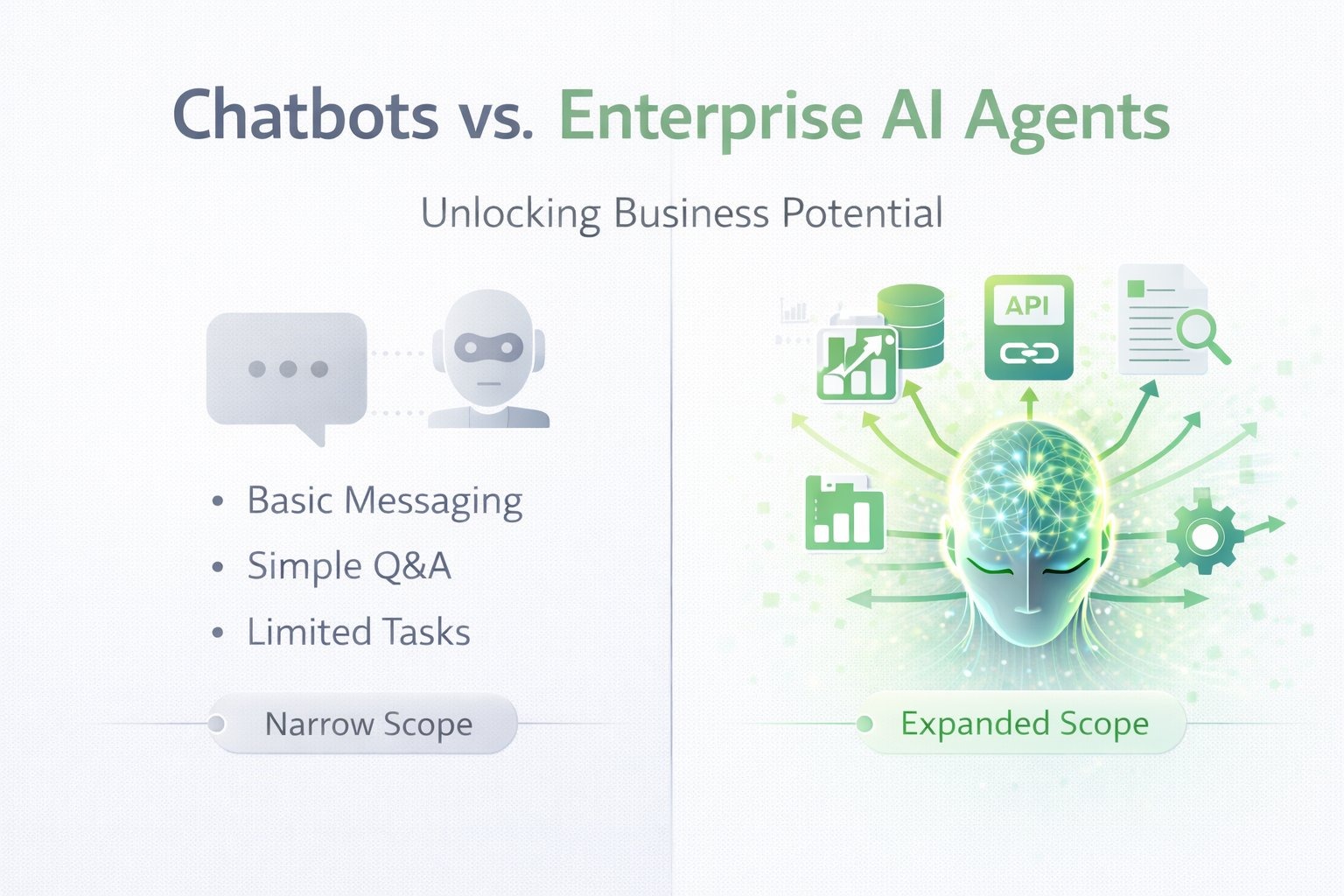
The technical landscape shifted significantly this week with Meta's strategic acquisition of the Chinese AI startup Manus. While the headlines focus on the geopolitical and corporate maneuvers, we’ve been looking at the underlying technological signal: the industry has officially moved past the 'chatbot' era. We are now firmly in the era of AI agents for enterprise—systems designed not just to talk, but to execute. At EnDevSols, we’ve been tracking this transition from passive LLMs to active agents for months, especially as technologies like the Model Context Protocol (MCP): Securing the Agentic Future emerge. This move by Meta confirms that the race is no longer about who has the best prose, but who can reliably automate complex, multi-step workflows.
The Meta-Manus Signal: Why Agents Are Winning the AI Race
For the last two years, the focus of generative AI has been primarily on retrieval and synthesis. We asked questions, and the AI gave us answers. However, Meta’s move to acquire Manus suggests a pivot toward advanced agentic capabilities and robust agentic AI frameworks. Manus, known for its work in agentic frameworks, represents the missing piece for many enterprise AI strategies: the ability to interact with external tools, navigate software interfaces, and manage long-term tasks without constant human hand-holding.
This shift isn't just about 'smarter' models; it's about a fundamental change in architecture. Traditional chatbots operate in a vacuum of text-in, text-out. Agents, by contrast, possess a 'loop'—they observe an environment, think, act using tools (like APIs or browser controllers), and then observe the result to decide their next step. This Action-Observation Loop is where the real business value lies, and it’s why Meta is willing to look globally for the talent and tech to master it.
The Critical Shift: From Chatbots to Task-Completing Agents
We’ve observed a common frustration among our clients: the 'Chatbot Plateau.' You deploy a RAG-based bot that answers questions about company policy, but when you ask it to actually file a leave request or update a CRM record, it hits a wall. The market is moving toward autonomous AI agents because businesses don’t just want information; they want outcomes. A chatbot tells you a customer is unhappy; an agent identifies the frustration, looks up the order history, calculates a potential refund, and drafts a resolution for approval.
However, this transition comes with significant risks. Moving from a read-only AI to a write-enabled AI introduces a host of security and reliability concerns. This is where most agent projects fail. They either lack the autonomy to be useful, or they have too much autonomy, leading to "hallucinated actions" that can corrupt data or disrupt services—a challenge we discuss in our guide on AI Hallucination Risk: Lessons from Google Health Crisis. To solve this, we advocate for a technical middle ground we call Bounded Autonomy.
Implementing the 'Bounded Autonomy' Model
The biggest hurdle in deploying agents like those being developed at Meta/Manus is trust. In our recent experiments, we’ve found that the only way to successfully integrate agents into production environments is through a structured safety framework. Bounded autonomy means giving an AI the power to act, but within a strictly defined 'sandbox' of rules and human intervention points.
1. Permissions and Scoped Access
An agent should never have 'root' access to your enterprise systems. Instead, it should operate with the principle of Least Privilege. If we are building a lead qualification agent, it should only have write access to specific CRM fields, not the ability to delete records or export the entire database. This is where Custom Software development meets AI—you need to build middleware that acts as a gatekeeper for the agent’s actions.
2. The Approval Loop (Human-in-the-Loop)
For high-stakes tasks, we implement mandatory approval triggers. The agent can do 90% of the work—finding the data, drafting the response, and preparing the transaction—but the final 'Execute' button must be pressed by a human. This ensures that the AI remains a 'Co-pilot' rather than a 'Rogue Pilot.' As the agent’s accuracy improves, you can gradually raise the threshold for what requires a human eye.
3. Logging and Rollback Capabilities
Unlike a chat history, which is just text, an agent's history is a sequence of system states. We’ve found that robust DevOps & Cloud integration is essential here. You need to log every API call the agent makes and, more importantly, have the ability to 'Rollback' the state of your database if an agent makes an error. Think of it as 'Git for Business Processes.'
Identifying Your First Agent Pilot: Start with ROI
You don't need to rebuild your entire infrastructure to benefit from agentic AI. In fact, the most successful implementations we’ve seen start with a single, high-friction workflow, such as the efficiency gains seen in our Education Technology / E-Learning Case Study. We recommend focusing on areas where the 'cost of a mistake' is low, but the 'volume of work' is high. Here are three workflows we are currently prototyping for clients:
- Support Triage and Resolution: Beyond just answering FAQs, agents can categorize tickets, pull relevant technical logs, and prepare a sandbox environment for a developer to troubleshoot.
- Automated Report Generation: An agent can reach out to various departments, collect data from disparate spreadsheets, normalize the formatting, and generate a draft of a weekly performance report.
- Lead Qualification: Agents can research a new lead’s LinkedIn profile, check their company’s recent news, and cross-reference their tech stack with your service offerings to provide a 'warm' briefing for your sales team.
"The goal of an agent isn't to replace the human; it's to eliminate the 80% of 'digital drudgery' that precedes the 20% of high-value decision making."
The Technical Reality of Multi-Agent Systems
As we look at what Meta is doing with Manus, it’s clear they aren't just building one 'Super AI.' They are likely building a Multi-Agent Orchestration layer. In this architecture, you have specialized agents (one for data retrieval, one for logic, one for UI interaction) that talk to each other. This modularity makes the system easier to debug and more resilient. We explored this in our Business Incubation / Entrepreneurship Education Case Study, where modularity drove 99% faster time-to-market.
For enterprise leaders, this means your enterprise AI strategy shouldn't be about finding one 'God Model.' It should be about building a platform that can coordinate multiple small, specialized tools. This is the core of our AI RAG for Enterprise approach: using RAG to give agents the context they need, then using agentic loops to turn that context into action.
Meta’s acquisition of Manus is a loud wake-up call: the window for 'just experimenting' with chatbots is closing. To stay competitive, businesses need to start building the scaffolding for AI agents for enterprise today. We recommend starting with a 2-3 week Agent Pilot Package—moving from discovery and prototyping to defining clear KPIs like time saved and cost deflection. Whether it's through custom software or advanced DevOps, the goal is to create a safe, ROI-driven path to automation. The tech is ready; the question is whether your guardrails are. We're still experimenting with these frameworks, but early results suggest that autonomous AI agents are the most significant leap in productivity we've seen this decade. Let's build something that actually does the work.