
By 2026, the novelty of large language models has faded, replaced by a rigorous demand for functional utility. For organizations seeking custom AI chatbot development, the challenge is no longer finding a model that can speak, but finding an AI chatbot development company capable of embedding that model into the complex machinery of a modern enterprise. The market is saturated with vendors who can build impressive demos, yet many fail when tasked with the technical rigors of production-scale deployment.
By 2026, the novelty of large language models has faded, replaced by a rigorous demand for functional utility. For organizations seeking custom AI chatbot development, the challenge is no longer finding a model that can speak, but finding an AI chatbot development company capable of embedding that model into the complex machinery of a modern enterprise. The market is saturated with vendors who can build impressive demos, yet many fail when tasked with the technical rigors of production-scale deployment.
The Industry Problem: The Demo-to-Production Gap
The most significant hurdle in enterprise chatbot development is the disconnect between a controlled pilot and a live business environment. Many organizations invest in business chatbot development services based on a polished initial presentation, only to find the solution lacks the production readiness required for actual operations. These bots often struggle with real-world data variability, fail to adhere to complex internal policies, or become isolated silos that cannot communicate with the broader tech stack.
Why Existing Approaches Fall Short
Early iterations of chatbots often relied on rigid decision trees or basic API wrappers that lacked context. These approaches scale poorly because they do not account for business workflow fit. When a chatbot operates outside of established workflows, it creates friction rather than efficiency. Learn How to Reduce Customer Support Costs With AI Chatbots properly, as without sophisticated escalation logic, these systems often frustrate users by failing to recognize when a high-stakes issue requires a seamless handoff to a human representative.
The Technology Shift: RAG and Deep Integration
The standard for custom AI chatbot services has shifted toward RAG capability (Retrieval-Augmented Generation). This technology allows the AI to ground its responses in a company’s specific, proprietary data, significantly reducing inaccuracies. However, RAG is only effective when paired with robust integrations. A modern enterprise bot must act as an orchestration layer, pulling data from CRMs, ERPs, and legacy databases to provide personalized, actionable assistance rather than generic answers.
The Essential Evaluation Criteria
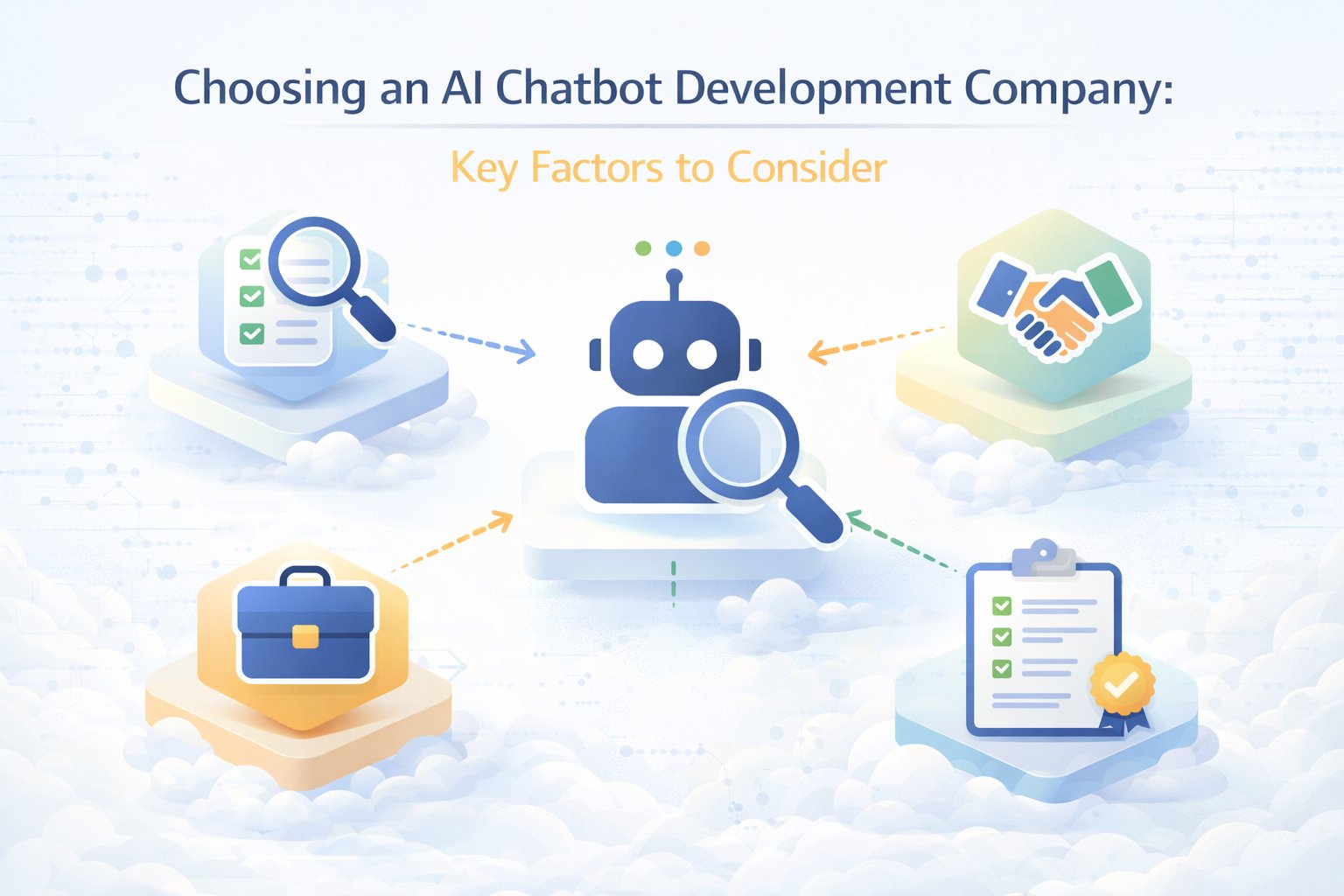
When vetting an AI chatbot development company, business leaders must prioritize the following technical and operational pillars:
- Security: Enterprise-grade security is the baseline. This includes data residency compliance, encryption standards, and strict protocols to ensure proprietary data is not used to train public models.
- Analytics: Effective deployment requires more than a transcript log. Look for partners who provide deep analytics that track sentiment, task completion rates, and the bot’s direct impact on operational overhead.
- Escalation Logic: The system must feature intelligent triggers that transition complex queries to human agents without losing context or forcing the user to repeat information.
- Workflow Fit: The solution must be designed around existing business processes, ensuring the AI enhances rather than disrupts the current employee or customer journey.
How It Works in Practice: Production Readiness
A production-ready chatbot is characterized by its resilience and reliability. In practice, this means the system has undergone rigorous testing against edge cases and possesses the architectural flexibility to evolve as business requirements change. Successful adoption involves moving beyond the chat interface to focus on the backend logic and data pipelines that power the interaction. This ensures that the custom AI chatbot development efforts result in a tool that actually solves business problems in real-time environments.
Choosing the right partner in 2026 requires looking past the interface and evaluating the underlying technical architecture and business alignment. To move from a proof-of-concept to a high-impact deployment, you need a partner focused on production readiness and business workflow fit. Ready to deploy a solution that delivers measurable results? Explore our custom business chatbot services to learn more about our enterprise chatbot development capabilities.
Choosing the right partner in 2026 requires looking past the interface and evaluating the underlying technical architecture and business alignment. To move from a proof-of-concept to a high-impact deployment, you need a partner focused on production readiness and business workflow fit. Ready to deploy a solution that delivers measurable results? Explore our custom business chatbot services to learn more about our enterprise chatbot development capabilities.