
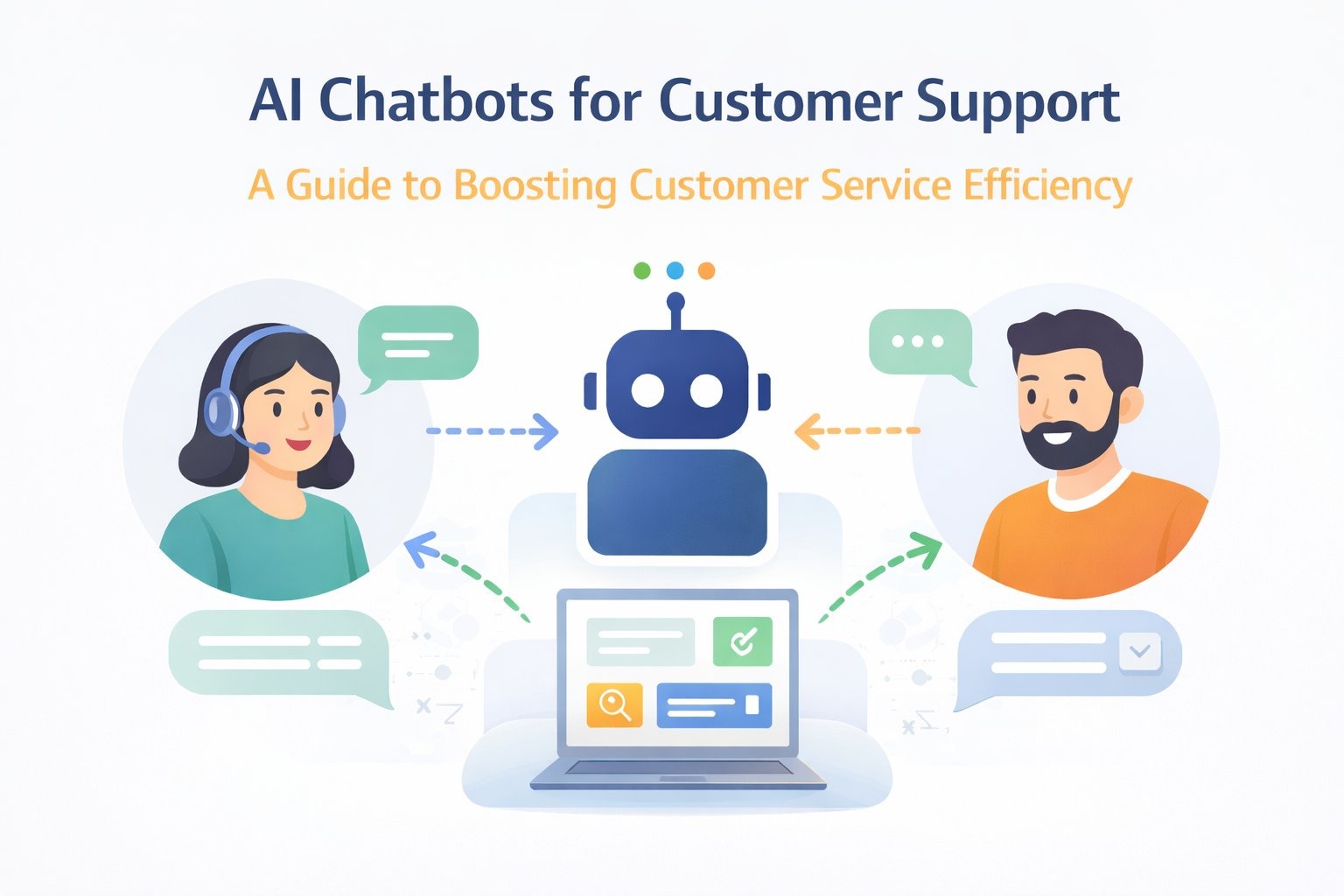
In the current macroeconomic landscape, the imperative for engineering leaders has shifted from growth at all costs to sustainable, high-efficiency operations. Implementing AI chatbots for customer support remains one of the primary drivers of operational expenditure (OpEx) reduction, yet it is also the most susceptible to transformation through Large Language Model (LLM) integration. The challenge for the CTO or VP of Engineering is not simply deploying a chatbot, but architecting a resilient, high-fidelity system that measurably reduces ticket volume while maintaining brand integrity and user trust. This guide details the architectural rigor required to move AI support from a experimental prototype to a core cost-efficiency layer through strategic Enterprise AI Software Engineering: Claude, GPT & Gemini implementations.
In the current macroeconomic landscape, the imperative for engineering leaders has shifted from growth at all costs to sustainable, high-efficiency operations. Implementing AI chatbots for customer support remains one of the primary drivers of operational expenditure (OpEx) reduction, yet it is also the most susceptible to transformation through Large Language Model (LLM) integration. The challenge for the CTO or VP of Engineering is not simply deploying a chatbot, but architecting a resilient, high-fidelity system that measurably reduces ticket volume while maintaining brand integrity and user trust. This guide details the architectural rigor required to move AI support from a experimental prototype to a core cost-efficiency layer through strategic Enterprise AI Software Engineering: Claude, GPT & Gemini implementations.
The Technical Imperative: Support as a Data Engineering Challenge
The business value of an AI chatbot is often measured in Deflection Rate and Mean Time to Resolution (MTTR). However, from an architectural standpoint, these are downstream metrics of retrieval quality and system integration. To achieve true customer support automation and cost reduction, the system must handle high-volume, repetitive queries with 99.9% accuracy, necessitating a move away from simple prompt-response cycles toward a robust Retrieval-Augmented Generation (RAG) framework.
The Economics of Automation
Cost reduction in support manifests in three primary tiers:
- Tier 1: Direct Deflection. Fully autonomous resolution of FAQs and common troubleshooting, preventing ticket creation.
- Tier 2: Agent Augmentation. Reducing Average Handle Time (AHT) by providing human agents with drafted responses and real-time knowledge surfacing.
- Tier 3: 24/7 Triage. Automating the classification and prioritization of urgent issues, ensuring human capital is allocated to the highest-value tasks.
Prerequisites & Modern Architecture
Before initiating implementation, the tech stack must be capable of supporting high-concurrency LLM interactions. The modern gold standard involves a decoupled architecture: an Ingestion Pipeline for knowledge, a Vector Database for semantic search, and an Orchestration Layer (such as LangChain or LlamaIndex) to manage the logic flow. For more details, see our Production RAG Implementation: 30-Day Enterprise Guide.
Core Tech Stack Competencies
- Vector Infrastructure: Selection of a performant vector store (e.g., Pinecone, Weaviate, or pgvector) capable of hybrid search (combining keyword and semantic matching).
- Knowledge Context: A centralized repository of structured (API docs, CRM data) and unstructured (Slack logs, PDF manuals) data.
- Observability: Implementation of tools like LangSmith or Arize Phoenix to trace LLM chains and monitor for hallucinations.
Phase-by-Phase Execution Roadmap
Phase 1: Knowledge Foundation & Ingestion
The efficacy of your chatbot is strictly capped by the quality of its context window. This phase focuses on transforming tribal knowledge into machine-readable formats. Engineering leads must implement Semantic Chunking strategies that preserve the context of support articles without exceeding token limits. This involves recursive character splitting and metadata tagging (e.g., tagging by product version or user tier) to ensure the retrieval engine pulls the most relevant data shards.
Phase 2: Core Logic & Retrieval Optimization
Standard RAG often fails in complex support scenarios due to poor retrieval. Implementation should utilize Multi-Query Retrieval or HyDE (Hypothetical Document Embeddings) to bridge the gap between user slang and technical documentation. Furthermore, the system must be designed with a Reasoning Loop that can ask clarifying questions when a user query is ambiguous, rather than guessing and providing incorrect technical advice.
Phase 3: System Integration & Escalation Logic
A chatbot that exists in a vacuum is a liability. Cost reduction is realized when the bot can perform actions. This requires Tool-Use (Function Calling) capabilities, allowing the LLM to interface with your internal APIs—for instance, to check order status or reset a subscription. Crucially, Escalation Logic must be hardcoded: if a user expresses high frustration (Sentiment Analysis) or if the model's confidence score drops below a specific threshold, the session must be seamlessly handed off to a human agent via Zendesk or Salesforce API, carrying over the full interaction transcript.
Phase 4: Production Optimization at Scale
Once the logic is sound, the focus shifts to Inference Optimization. To manage the cost of the AI itself, architects should implement a multi-model strategy: using smaller, cheaper models (like GPT-3.5 or Claude Haiku) for initial triage and intent classification, and reserving larger models (GPT-4 or Claude Opus) for complex technical troubleshooting. Prompt Caching and Response Streaming are essential for reducing perceived latency and improving user satisfaction. Review our Generative AI for Contact Centers: 2026 Strategy for deeper insight into scaling operations.
Anti-Patterns & Mitigation
"The most expensive chatbot is the one that gives a wrong answer confidently."
Avoid the following pitfalls to ensure long-term ROI:
- The Infinite Apology Loop: Bots that repeatedly apologize without escalating or providing a solution. Mitigation: Implement a 'max-turn' limit before forced human handoff.
- Knowledge Staleness: Using stale data from a fixed training set. Mitigation: Use a dynamic RAG pipeline that refreshes its vector index every time a knowledge base article is updated.
- Over-Engineering the UI: Focusing on 'personality' before 'utility'. Mitigation: Prioritize clear, concise technical resolution over conversational fluff.
Production Readiness Standards
Moving from a proof-of-concept to an enterprise-grade support layer requires strict adherence to security and reliability standards. This includes PII Redaction (ensuring no customer credit card or PII reaches the LLM provider), Rate Limiting to prevent API abuse, and Semantic Caching to serve identical queries from a cache rather than re-running the LLM, significantly reducing latency and compute costs.
Reducing customer support costs via AI chatbots for customer support is not a 'set and forget' project; it is a continuous engineering discipline. By architecting for retrieval quality, integrating deeply with existing business logic, and maintaining a human-in-the-loop safety net, engineering leaders can deliver a system that significantly lowers OpEx while improving the customer experience. To begin, audit your current support tickets for the highest-frequency, lowest-complexity queries—this is your automation North Star. If you are ready to build a high-fidelity AI support layer that drives real ROI, our team is ready to assist in the architectural design and deployment.
Reducing customer support costs via AI chatbots for customer support is not a 'set and forget' project; it is a continuous engineering discipline. By architecting for retrieval quality, integrating deeply with existing business logic, and maintaining a human-in-the-loop safety net, engineering leaders can deliver a system that significantly lowers OpEx while improving the customer experience. To begin, audit your current support tickets for the highest-frequency, lowest-complexity queries—this is your automation North Star. If you are ready to build a high-fidelity AI support layer that drives real ROI, our team is ready to assist in the architectural design and deployment.