
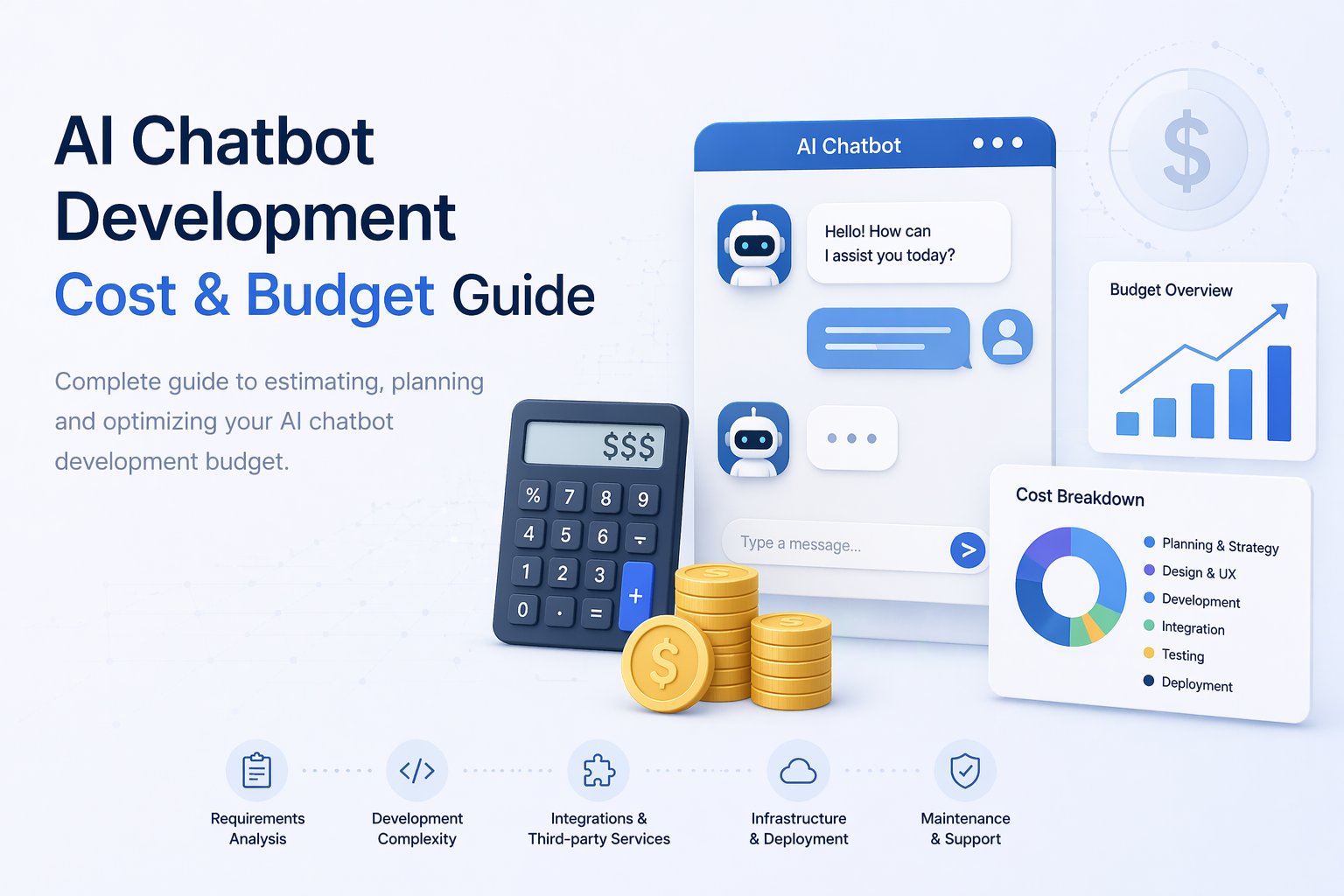
Scoping an AI chatbot project requires moving beyond rigid pricing models to evaluate specific technical drivers. This guide provides a framework for engineers and project leads to understand how the custom AI chatbot development cost—ranging from retrieval-augmented generation to multi-channel deployment—directly influences the total project scope.
Scoping an AI chatbot project requires moving beyond rigid pricing models to evaluate specific technical drivers. This guide provides a framework for engineers and project leads to understand how the custom AI chatbot development cost—ranging from retrieval-augmented generation to multi-channel deployment—directly influences the total project scope.
What You're Building and Why
You are building a comprehensive technical scope and AI chatbot development budget for a custom AI chatbot. The goal is to move away from arbitrary flat-fee estimates and toward a precise calculation based on technical requirements. Understanding How to Reduce Customer Support Costs With AI Chatbots can help justify these initial investments. This ensures that the final product meets enterprise standards for reliability, security, and functionality.
Prerequisites
- Defined business use cases and target user personas.
- Inventory of internal data sources (PDFs, databases, or APIs) for RAG.
- Selection of primary deployment channels (Web, Slack, WhatsApp, etc.).
- Clear compliance and security requirements for data handling.
Architecture Overview
The budget of an AI chatbot is dictated by five primary architectural layers. Each layer adds a specific level of complexity and cost:
- Channels and Multilingual Support: The frontend interfaces where the bot lives and the number of languages it must process.
- Workflow Depth and Integrations: The connection to external systems (CRM, ERP) to perform actions rather than just answering questions.
- Intelligence Layer (RAG and Memory): The implementation of Retrieval-Augmented Generation and session persistence.
- Safety and Governance: The guardrails and filtering systems that ensure output quality.
- Operations: The analytics and maintenance infrastructure required for post-launch performance.
Step-by-Step Implementation
Phase 1: Define Channel and Language Scope
Determine the breadth of your deployment. Building for a single web interface is significantly less resource-intensive than a multilingual support system that must function across multiple social and internal messaging channels simultaneously.
Phase 2: Map Workflow Depth and Integrations
Identify the level of autonomy the bot requires. A bot that provides static answers costs less than one requiring deep integrations with third-party APIs to execute real-time tasks like processing orders or updating customer records.
Phase 3: Architect Memory and RAG Systems
Implement RAG to allow the bot to access proprietary data. The cost here is driven by the complexity of the data pipeline, the vector database selection, and the requirement for persistent memory. See how we optimized this in our Enterprise Software Case Study to see the performance impact of advanced retrieval.
Phase 4: Implement Guardrails and Analytics
Develop the guardrails necessary to prevent hallucinations and ensure brand alignment. Simultaneously, integrate analytics suites to track user interactions and model performance, which is critical for iterative improvement.
Common Mistakes
The most frequent error in budgeting is underestimating maintenance costs. AI models and data sources are not static; they require consistent monitoring, fine-tuning, and updates to remain accurate and secure over time.
Testing and Validation
Validation must focus on both the accuracy of the RAG system and the reliability of the integrated workflows. Use your analytics data to perform stress tests on guardrails and ensure that the bot handles edge cases without breaking the established logic.
Production Considerations
When moving to production, the focus shifts to enterprise chatbot development standards. This includes scaling the infrastructure to handle concurrent users and ensuring that the maintenance budget accounts for model drift and API updates from integrated services. If you are wondering how much does a custom AI chatbot cost at scale, these factors are the primary variables.
Understanding these specific drivers allows for a realistic and transparent budget that aligns with technical goals. To see how these components come together, explore our business chatbot development services.
Understanding these specific drivers allows for a realistic and transparent budget that aligns with technical goals. To see how these components come together, explore our business chatbot development services.