
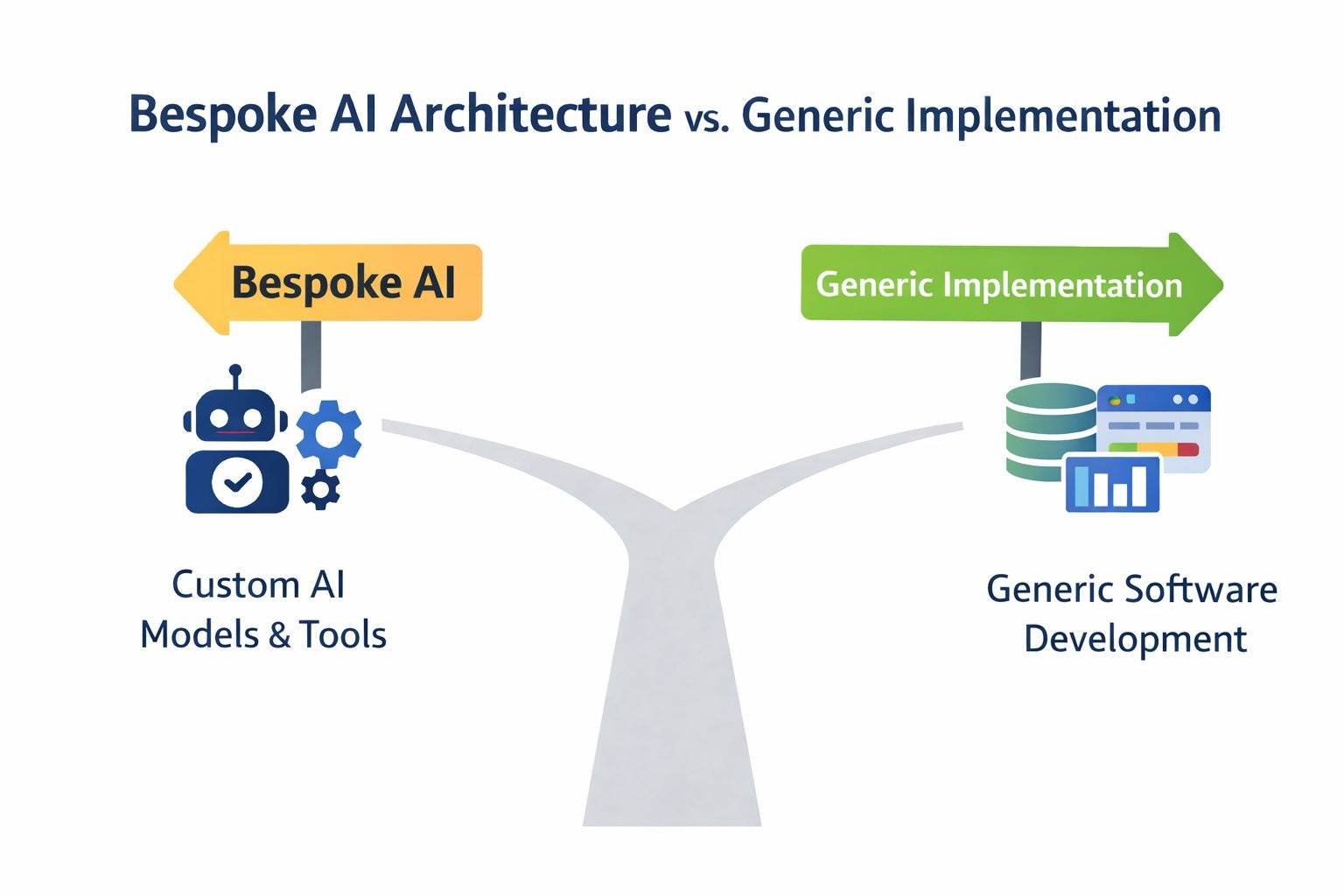
In 2026, the global enterprise has moved past the initial delirium of generative AI. The era of the 'flashy demo' has been replaced by a rigorous demand for measurable ROI and operational stability. For the C-suite, the fundamental strategic question is no longer whether to adopt AI, but how to design a bespoke AI architecture. The choice between partnering with a specialized development firm or a generic implementation agency now represents the difference between The 2026 Enterprise AI Standard: A Strategic Selection and a costly legacy of technical debt. This framework analyzes the transition from AI experimentation to hardened production, providing leaders with the intelligence required to navigate this critical infrastructure decision.
In 2026, the global enterprise has moved past the initial delirium of generative AI. The era of the 'flashy demo' has been replaced by a rigorous demand for measurable ROI and operational stability. For the C-suite, the fundamental strategic question is no longer whether to adopt AI, but how to design a bespoke AI architecture. The choice between partnering with a specialized development firm or a generic implementation agency now represents the difference between The 2026 Enterprise AI Standard: A Strategic Selection and a costly legacy of technical debt. This framework analyzes the transition from AI experimentation to hardened production, providing leaders with the intelligence required to navigate this critical infrastructure decision.
In 2026, the global enterprise has moved past the initial delirium of generative AI. The era of the 'flashy demo' has been replaced by a rigorous demand for measurable ROI and operational stability. For the C-suite, the fundamental strategic question is no longer whether to adopt AI, but how to design a bespoke AI architecture. The choice between partnering with a specialized development firm or a generic implementation agency now represents the difference between The 2026 Enterprise AI Standard: A Strategic Selection and a costly legacy of technical debt. This framework analyzes the transition from AI experimentation to hardened production, providing leaders with the intelligence required to navigate this critical infrastructure decision.
The Strategic Landscape: Why 2026 is the Year of Production Hardening
The market has reached a point of maturity where 'AI for AI's sake' is an obsolete strategy. Modern enterprises are now integrating intelligence into the core of their operations, moving beyond simple API wrappers to complex, multi-agent systems. This shift is driven by three primary catalysts. First, the NIST Generative AI Risk Management Framework has established a new global baseline for reliability and governance, making safety a prerequisite for deployment. Second, data sovereignty has become a non-negotiable board-level concern. Third, the 'Prototype Trap'—where internal teams build a working demo but fail to reach 99.9% reliability—has cost organizations millions in lost time and resources.
The Imperative of Strategic Alignment
In this landscape, the development partner you choose is no longer just a technical vendor; they are a strategic architect of your firm's future intelligence. Choosing a partner that cannot connect high-level business strategy with hardened technical delivery creates a systemic risk that often takes years to remediate.
Option A: Bespoke AI Engineering (The Partnership Model)
Bespoke AI development centers on creating custom-built architectures—such as RAG vs. Fine-Tuning vs. Prompting: 2026 Strategic Guide systems and fine-tuned Large Language Models (LLMs)—that are tailored to an organization's specific data ecosystem and business logic. This approach is characterized by deep product thinking rather than simple task execution.
- Strategic Pros: High alignment with unique business processes, complete control over data security, and systems designed for long-term scalability.
- Technical Rigor: Implementation of secure architectures that adhere to NIST standards, ensuring that reliability and risk controls are baked into the code, not added as an afterthought.
- Total Cost of Ownership (TCO): While initial capital expenditure may be higher, the long-term TCO is often lower due to reduced technical debt and the elimination of 'per-seat' licensing fees associated with generic SaaS platforms.
Ideal for organizations where AI is a core differentiator, such as proprietary healthcare diagnostics, automated legal analysis, or the specialized solutions seen in our EdTech / Religious Knowledge & Reference Case Study.
Option B: Commoditized AI Implementation (The Generic Agency)
This model involves hiring agencies that focus on rapid deployment using off-the-shelf tools and pre-built templates. While attractive for low-stakes internal projects, it often lacks the depth required for production-grade enterprise software.
- Strategic Cons: Limited customization, high risk of 'black box' dependencies, and a failure to address the nuances of enterprise-grade security and integration.
- The Prototype Trap: These agencies excel at creating impressive front-ends for simple chatbots but often struggle when faced with the complexities of backend integration and the rigorous governance demands of 2026.
- Value Proposition: Speed to market for non-critical, low-risk applications where data privacy and long-term scalability are secondary concerns.
Head-to-Head Strategic Matrix: Identifying the Differentiators
When evaluating potential partners, leadership must look beyond the pitch deck and assess three critical pillars of maturity:
- Scalability and Integration: Does the partner understand how to integrate AI with legacy ERP and CRM systems without compromising performance? Generic agencies often provide silos; bespoke partners provide bridges.
- Governance and Security: Does the partner have a proven methodology for model auditing, bias mitigation, and data sovereignty? In 2026, security is not a feature—it is the foundation.
- Product Thinking vs. Coding: A superior partner asks 'Why should we build this?' before asking 'How?' They focus on measurable business outcomes rather than technical vanity metrics.
The Hidden Variables: What Seasoned Leaders Must Know
Experienced buyers understand that the most significant risks are often invisible during the RFP process. Model Selection is a prime example: a partner should not be wedded to a single provider (e.g., OpenAI or Anthropic) but should possess the expertise to select the right model for the specific task based on cost, latency, and compliance. Furthermore, the ability to ship beyond the prototype involves rigorous testing for hallucination rates and latency at scale, areas where many generalist developers fail.
"Reliability and risk controls must be part of the architectural blueprint, not a layer added after the system is built."
Choosing a custom AI development company in 2026 requires a shift from evaluating technical talent to evaluating institutional wisdom. EnDevSols positions itself at the intersection of strategic consulting and rigorous engineering, building production-ready systems that transform operational capabilities. To begin your transition from experimentation to production-grade AI, the first step is a comprehensive audit of your current AI roadmap against the NIST framework. We invite you to contact our senior architects for a strategic consultation to ensure your next investment delivers the sustainable ROI your organization demands.
Choosing a custom AI development company in 2026 requires a shift from evaluating technical talent to evaluating institutional wisdom. EnDevSols positions itself at the intersection of strategic consulting and rigorous engineering, building production-ready systems that transform operational capabilities. To begin your transition from experimentation to production-grade AI, the first step is a comprehensive audit of your current AI roadmap against the NIST framework. We invite you to contact our senior architects for a strategic consultation to ensure your next investment delivers the sustainable ROI your organization demands.
Choosing a custom AI development company in 2026 requires a shift from evaluating technical talent to evaluating institutional wisdom. EnDevSols positions itself at the intersection of strategic consulting and rigorous engineering, building production-ready systems that transform operational capabilities. To begin your transition from experimentation to production-grade AI, the first step is a comprehensive audit of your current AI roadmap against the NIST framework. We invite you to contact our senior architects for a strategic consultation to ensure your next investment delivers the sustainable ROI your organization demands.