

A strong portfolio matters. Process, transparency, and long-term maintainability predict outcomes more reliably. The right partner shows you working software early and leaves you in full control of what they build.
This guide is for founders, CTOs, product leaders, and operations leaders who are comparing vendors. It covers the decision criteria that matter, the red flags to watch for, how to compare pricing models, and a step-by-step shortlist process you can use this week.
What Should You Define Before Contacting Software Development Companies?
Before you contact any vendor, define the problem you are solving, the workflow it affects, and the systems the new software must connect to. Without this baseline, every proposal will look reasonable, and you will have no fair way to compare them. Clear inputs produce comparable estimates.
Most custom software projects start because something stopped scaling. A spreadsheet became the system of record. Six tools need data re-keyed between them. An off-the-shelf product almost fits, but the workarounds have become the real process. Name your version of that problem in plain language.
Then document these five things:
- The business outcome. Examples include faster quoting, fewer manual handoffs, or live reporting instead of month-end exports.
- The current workflow. Map who does what, in which tool, and where errors or delays happen. Include the informal steps that live in people's heads.
- Existing systems. List your CRM, ERP, accounting, identity provider, and any legacy databases. Integrations are often the biggest cost driver, so this list matters.
- Constraints. These include budget range, deadlines, compliance needs (such as HIPAA, SOC 2, or data residency), and who will own the system after launch.
- Success criteria. Define how you will know the project worked six months after launch.
Confirm That Custom Is the Right Call
Custom software is not automatically better. It makes sense when your workflow is a competitive advantage, when integration between systems is the real problem, or when per-seat licensing and workarounds now cost more than owning the software.
Buying off-the-shelf is usually smarter when the process is standard, a mature product covers most of your needs, or nobody internally will own the system after launch. A trustworthy vendor will tell you when buying is the better option, even if it costs them the project.
Key Criteria for Choosing the Right Custom Software Development Company
The most important criteria are delivery process, technical judgment, domain fit, communication, and code ownership. Evaluate each with evidence, not promises. Ask vendors to show artifacts, explain trade-offs, and walk you through how they handled problems on past projects.
Delivery Process and Methodology
A vendor's process tells you more than their client logos. Nearly every firm says "we use Agile." The real question is what that means in practice.
Ask each vendor to describe:
- How discovery and scoping work, and what written output you receive
- How long each build cycle is, and what you see at the end of each one
- How change requests are estimated, approved, and tracked
- When testing starts, and whether QA is a dedicated role
- How releases are deployed and rolled back
Look for short build cycles that end with working software you can click through, not status slides. Two-week cycles are common because they give you frequent checkpoints to catch misunderstandings before they become expensive. If a vendor cannot describe their process in specific terms without prompting, treat that as a warning.
Technical Judgment and Stack Choices
The right technology stack should follow your requirements, not the vendor's habits. Ask why they would choose a particular framework, database, or cloud platform for your project, and what the trade-offs are.
Good answers mention maintainability, hiring availability, performance needs, and cost of operation. For example, a team might recommend Python with FastAPI for an integration-heavy backend, PostgreSQL for relational operational data, and React or Next.js for the interface. The specific tools matter less than the reasoning behind them.
If your project includes AI features, ask how the vendor decides when AI is the right tool. A credible team will say that a deterministic rule is often more reliable than a language model, and that AI belongs where it clearly earns its place, such as document extraction, semantic search, or assisted drafting with human review.
Relevant Experience and Proof of Delivery
Review case studies for outcomes, not screenshots. Strong case studies describe the original problem, the constraints, what was built, and what changed afterward.
Prioritize vendors who have solved similar problems, even in a different industry. A team that has built scheduling and dispatch systems understands state management, permissions, and offline sync, which carry across sectors. Then speak with references. Ask how the vendor communicated bad news, how they handled scope changes, and whether the client would hire them again.
Communication and Access to the Team
Communication failures usually show up as scope or timeline failures later. Use the sales process as a preview. Notice how quickly they respond, whether proposals use plain language, and whether they can explain a technical trade-off to a non-engineer.
Confirm that you will have direct access to the people building your product, including a technical lead. Also check timezone overlap and agree on a meeting rhythm before signing.
Use a Weighted Scorecard
A simple scorecard keeps your evaluation objective when several vendors look similar. Adjust the weights to fit your priorities.
| Criterion | What to Look For | Suggested Weight |
| Delivery process | Written scoping output, short build cycles, working software each cycle | 25% |
| Integration capability | Experience with your systems, clear integration plan, data migration approach | 20% |
| Technical judgment | Stack choices justified by your requirements, honest trade-offs | 15% |
| Ownership and handover | Full code and infrastructure ownership, documentation, training | 15% |
| Relevant experience | Similar problems solved, credible references | 15% |
| Communication | Direct team access, plain language, timezone overlap | 10% |
Integration, Ownership, and Maintenance: The Long-Term Questions
Integration, ownership, and maintenance decide what the software costs you over years, not months. Ask how the vendor will connect to your existing systems, who owns the code and infrastructure at handover, and what happens if you stop working together. These answers matter more than the launch date.
Integrations Are Where Projects Fail
Most operational software breaks at the seams between systems. A well-documented REST API is straightforward to connect. An undocumented legacy database, or a vendor API with strict rate limits and no sandbox, is not.
Ask each vendor:
- Which of our systems have you integrated with before?
- How will you handle authentication, such as SSO through Okta, Entra ID, or Google Workspace?
- What happens when a connected system is down or returns bad data?
- How will you test integrations before go-live?
A good vendor treats integration as scoped engineering work with its own estimate, not a line item squeezed in at the end.
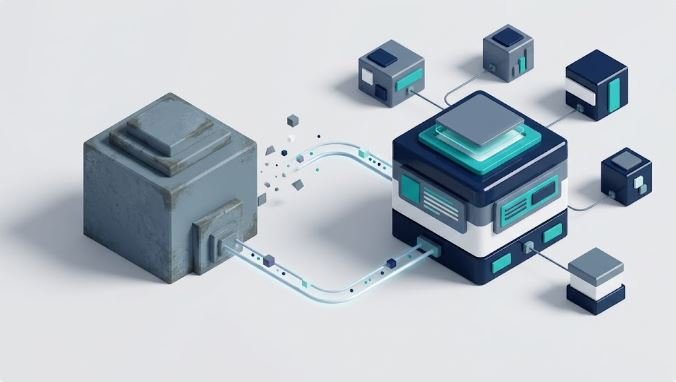
Modernizing Legacy Systems Without a Risky Cutover
If you are replacing an existing system, ask how the vendor avoids an all-or-nothing rewrite. Big-bang cutovers fail often because they force every risk into a single weekend.
The safer approach is incremental. Teams often call it the strangler pattern: new functionality is built alongside the old system, and traffic moves across piece by piece. Data migration should also be scoped as its own project, with validation and reconciliation, because legacy data is rarely as clean as expected. In some cases, the best answer is not replacement at all, but a modern API and interface placed over a system that still works.
Code Ownership and Exit Terms
Read the contract for intellectual property terms before anything else. You should own the full source code, infrastructure configuration, and documentation, with no licensing or per-seat fees afterward.
Also confirm that cloud accounts, domains, and repositories are created in your name, or are transferred at handover. If you can move the system in-house or to another vendor without that vendor's permission, you have real ownership.
Maintenance and Support After Launch
Software keeps changing after launch. Dependencies need security patches, integrations change their APIs, and users request new features. Ask what support looks like:
- Response times for critical issues
- How enhancement requests are scoped and prioritized
- Whether monitoring and alerting are included
- What documentation, runbooks, and training your team receives at handover
A vendor who documents well and writes code that another team can pick up is giving you a genuine choice about who maintains it.
How to Compare Pricing Models and Estimates
The right pricing model depends on how well-defined your scope is. Fixed price suits a tightly defined scope, time and materials suits evolving requirements, and milestone-based pricing sits between the two. Whatever model you choose, compare what drives each estimate, not just the final number.
| Model | Best For | Main Risk | How to Protect Yourself |
| Fixed price | Small, well-defined projects | Change orders, or quality cuts to stay on budget | Insist on a detailed scope and a clear change process |
| Time and materials | Evolving products and discovery-heavy work | Lower budget predictability | Set cycle-level budgets and review progress every cycle |
| Milestone-based | Phased delivery with clear checkpoints | Vague milestone definitions | Define acceptance criteria for each milestone in writing |
What Actually Drives the Estimate
Two projects with similar feature lists can differ several-fold in cost. Screen count is rarely the main factor. The bigger drivers are:
- Number and quality of integrations
- Data migration scope and data quality
- Workflow complexity, including approvals, permissions, and audit trails
- Compliance and security requirements
- Offline or mobile use with unreliable connectivity
- Who owns the system afterward, which affects documentation and training
Why a Paid or Formal Scoping Phase Is Worth It
Reliable estimates require understanding your workflow and systems first. A vendor who quotes a firm number after a single call is either padding heavily or underquoting to win the deal.
A structured scoping phase should produce a written scope and a cost range. Ideally, that document is yours to keep and use with other vendors. It also becomes the baseline you measure delivery against.
Red Flags When Choosing a Software Development Company
The clearest red flags are vague proposals, quotes far below the market, blocked access to developers, and unclear ownership terms. Each one predicts a specific problem later, usually scope creep, quality issues, or lock-in. If you see two or more, walk away.
Watch for these warning signs during evaluation:
- No discovery before pricing. A firm price before anyone has examined your workflow or systems is a guess.
- A proposal without deliverables. If milestones, responsibilities, and acceptance criteria are missing, execution will be just as loose.
- A quote far below others. The savings usually come from junior staff, thin QA, or skipped testing.
- "We use Agile" with no detail. Ask about cycle length, demos, and change control. Generic answers mean there is no real process.
- No access to the build team. If every message goes through an account manager, feedback slows and accountability fades.
- QA as an afterthought. Testing should start early and have a clear owner.
- Ownership fees or retained IP. Extra charges to release source code, or licenses on software you paid to build, signal lock-in.
- Promising everything. A partner who never pushes back on scope, timeline, or whether you need custom software at all is selling, not advising.
- No plan for after launch. Missing documentation, handover, or support terms leaves you exposed if the relationship ends.
A Practical Shortlist and Checklist for Choosing a Custom Software Development Partner
Use a structured, staged process: build a long list, narrow it with written questions, run scoping conversations with two or three finalists, and decide using a weighted scorecard. This approach takes a few weeks but prevents months of rework. It also gives every vendor a fair, comparable test.
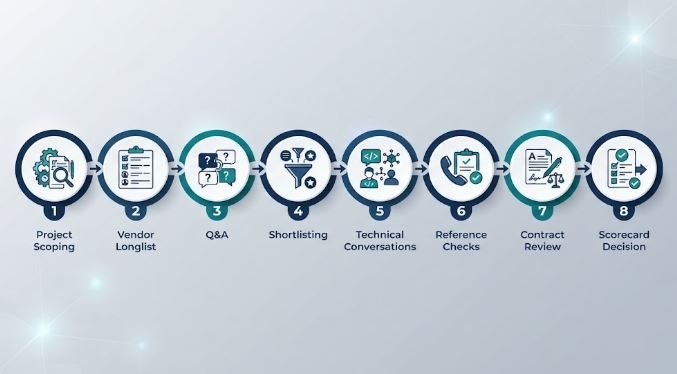
Step-by-Step Vendor Selection Process
- Write a one-page brief. Include the problem, current workflow, systems involved, constraints, and success criteria.
- Build a long list of five to eight vendors. Look for firms with case studies that match your problem type, not just your industry.
- Send the same written questions to each. Ask about process, integration experience, ownership terms, and support. Compare the answers side by side.
- Shortlist two or three finalists. Drop anyone who gave vague answers or skipped questions.
- Run a scoping conversation with each finalist. Bring your technical lead or an advisor. Note who asks the sharpest questions about your workflow.
- Check references. Ask how problems were handled, not only whether the project shipped.
- Review the contract carefully. Confirm IP ownership, infrastructure ownership, change control, acceptance criteria, and exit terms.
- Score and decide. Use your weighted scorecard and choose the partner with the strongest evidence, not the smoothest pitch.
Pre-Signing Checklist
Before you sign, confirm that you can check every item below:
- The vendor understands the business problem, not just the feature list
- You received a written scope with a cost range and clear assumptions
- Build cycles are short, and each one ends with working software
- Integrations with your existing systems are scoped as real work
- Data migration has its own plan, if needed
- You will have direct access to the technical lead and developers
- QA has a named owner and starts early
- You will own 100% of the source code and infrastructure at handover
- Documentation, runbooks, and training are part of delivery
- Support terms and response times are defined in writing
- References confirmed the vendor handled problems honestly
How EnDevSols Approaches Custom Software Projects
At EnDevSols, these criteria shape how we work. Our custom software development services begin with a scoping assessment that maps your workflow, the systems involved, and where the real cost sits. You receive a written scope and cost range, and it is yours to keep whether or not you build with us.
From there, we build around your actual workflow rather than a template, delivering in two-week cycles with working software at the end of each one. Integration and modernization are treated as core engineering work, including incremental replacement of legacy systems and data migration scoped as its own project. When workflows also involve multi-step tasks that could run with approvals and audit trails, our AI agents and workflow automation team can extend the system where it genuinely helps. At handover, you own the full code and infrastructure. You can review custom software case studies to see the kinds of systems we have built.
FAQs
How do I choose the right custom software development company?
Define your problem, workflow, systems, and success criteria first. Then evaluate vendors on delivery process, integration experience, technical judgment, communication, and code ownership, using a weighted scorecard. Choose based on evidence from scoping conversations and references, not the lowest quote or the most polished pitch.
How much does custom software development cost?
There is no reliable flat price, because cost depends mainly on integrations, data migration, workflow complexity, and compliance needs rather than screen count. A focused internal tool and a multi-team operational platform can differ by an order of magnitude. The most accurate way to get a number is a scoping phase that produces a written scope and cost range.
Is fixed price or time and materials better for custom software?
Fixed price works best when the scope is small and well-defined. Time and materials suits products where requirements will evolve as you learn. Many teams combine approaches, using a fixed-scope discovery phase followed by cycle-based delivery with a budget reviewed every two weeks.
Should I outsource custom software development or build an in-house team?
Build in-house when the software is your core product and you need full-time ownership over many years. Outsourcing makes sense for internal operational tools, integrations, and modernization work, where you need senior engineering without hiring a permanent team. Full code ownership and good documentation keep your options open either way.
What should a custom software development contract include?
The contract should confirm that you own all source code, infrastructure configuration, and documentation. It should also define scope, acceptance criteria, change control, payment terms, support commitments, and exit terms. Make sure cloud accounts and repositories are in your name, or are transferred to you at handover.
Want to see what your project would take to build? Discuss your software requirements with EnDevSols and request a scoping assessment that maps your workflow, systems, and cost range before any build commitment.