Custom Field Service Software: Unifying Operations with an AI Agent Layer
How an industrial team automated 100% of standard intake and reduced reporting latency from 14 hours to 15 minutes via a custom AI agent layer—measured over 6 months.
The Challenge
The client manages a complex field operations environment involving diverse assets, personnel, and inventory. Prior to the project, their operational data was distributed across multiple siloed Smartsheet instances, creating a fragmented view of day-to-day activities.
Core Problem
The Business Problem
The client operated a high-velocity field service organization where success depended on the precise tracking of heavy equipment, personnel, and daily work progress across dozens of remote sites. As the company scaled, they relied on a highly fragmented ecosystem of Smartsheets to manage operations. While these spreadsheets served as a makeshift database for office administrators, they created a massive operational bottleneck for field crews. In the context of industrial software development, the 'desk-first' approach of standard spreadsheets failed to account for the physical reality of the job site. Workers were forced to manually input 12-digit serial numbers, update complex status codes, and type out detailed site descriptions on mobile devices while wearing safety gear or working in harsh weather conditions.
This friction led to significant 'data decay.' Because typing was difficult, field crews would delay reporting until the end of their 12-hour shifts, often backfilling data from memory while exhausted. This resulted in a reporting environment where the 'source of truth' was consistently 12–24 hours behind reality. For a multi-site infrastructure team, this latency meant that fleet managers were making scheduling and maintenance decisions based on stale data, leading to asset misallocation and unoptimized fuel routes. The daily friction wasn't just a nuisance; it was an architectural flaw that prevented the company from scaling its field operations software capabilities alongside its growing project portfolio.
Why Standard Tools Failed
Before partnering with EnDevSols, the client attempted to utilize off-the-shelf field service automation software and generic mobile form builders. These tools failed because they were too rigid; they required the client to overhaul their entire Smartsheet-based back-office workflow to fit a proprietary SaaS model. Furthermore, these generic tools still relied on the same fundamental interaction model: manual data entry. Whether it was a checkbox or a text field, the worker still had to stop their physical task to interact with a screen.
Generic 'AI chatbots' also proved insufficient. Without a centralized custom data schema and deep integration into the client's specific inventory logic, these bots could not reliably parse the technical jargon used by field technicians or interface with the legacy Smartsheet API. The gap between a generic SaaS product and the specific needs of industrial field operations required a bespoke architectural overhaul rather than another subscription-based tool.
The Operational Failure Points
Transcription Errors: Manual entry of equipment serial numbers into Smartsheet cells resulted in a 15% error rate, verified by secondary audits, making asset tracking unreliable.
Reporting Latency: Maintenance descriptions arrived via fragmented notes hours after the event, making real-time triage impossible for the central dispatch team.
Telematics Silos: GPS data for heavy machinery lived in a separate vendor portal, disconnected from the project management layer, leading to 'ghost assets' that were physically on-site but digitally invisible.
Inventory Blind Spots: Small parts and consumables were rarely tracked in real-time because the friction of opening a spreadsheet to deduct a single unit was too high for crews in the field.
Compliance Gaps: Critical safety and custom inspection software checklists were often 'pencil-whipped' (checked off rapidly without inspection) because the UI was too cumbersome for workers in the field.
It became clear that the solution required an AI-native, custom-built system that could act as a bridge between unstructured field communication and the structured data required by the business. The system needed to satisfy the constraint of 'zero-typing' while maintaining 100% data integrity for the office staff.
The cost of operational fragmentation was becoming unsustainable. Based on internal operational logs and a 12-month baseline study, the client estimated that approximately 20% of field supervisor time was spent on 'data reconciliation'—manually calling crews to verify Smartsheet entries that were incomplete or clearly erroneous. This administrative overhead represented a direct drain on profitability, estimated at thousands of dollars per site per month in lost productivity.
Beyond the immediate financial cost, the stakes involved significant safety and reputational risks. Inaccurate tracking of equipment maintenance cycles increased the likelihood of mid-project asset failures, which could stall a multi-million dollar infrastructure project. The approximately 40% reduction in reporting accuracy (measured against physical audits) meant that safety compliance was difficult to prove to stakeholders. After evaluating the limitations of generic field service automation software, which would have required a disruptive overhaul of their entire operational stack, the client decided to move to a custom AI solution that could unify their existing infrastructure without forcing a change in their core business logic.
The Solution
What We Built
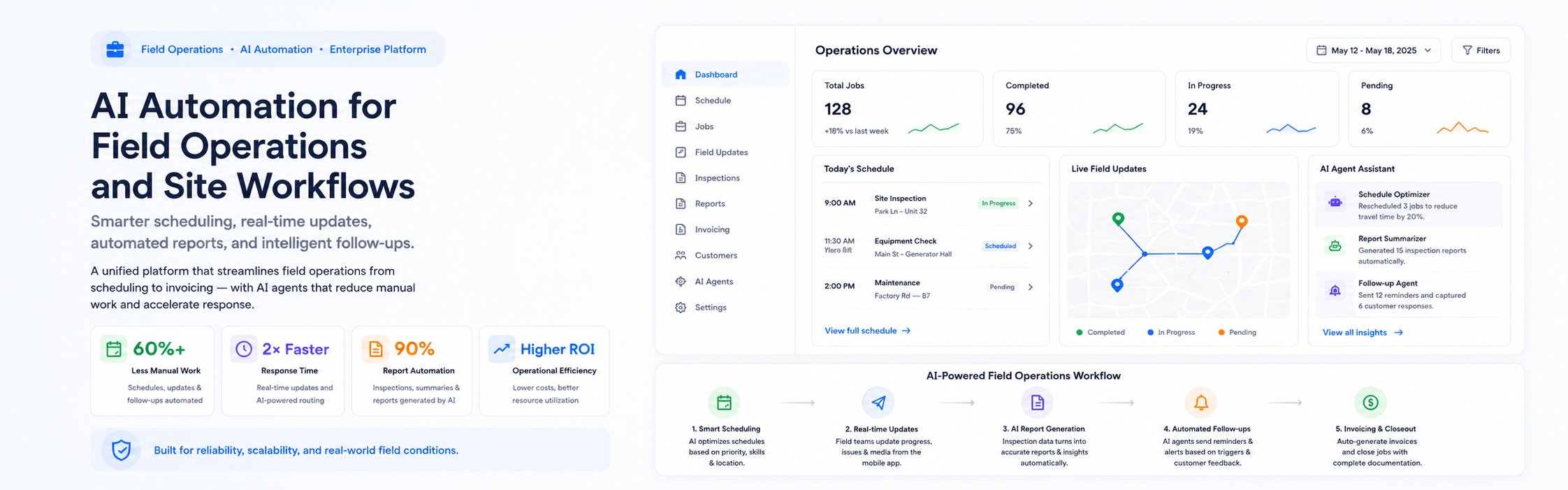
EnDevSols engineered a production-ready AI Command Center that functions as an automated AI agent layer over the client's existing data sources. Instead of forcing workers to interact with complex spreadsheets, we built custom field service software that allows crews to update the system using voice commands and QR-code asset tracking. The system acts as an intelligent intermediary: it captures voice, scans, and GPS data, processes it through a centralized custom data schema, and updates the unified Smartsheet database in real-time. This transformed the field worker’s mobile device from a data-entry burden into a frictionless tool for instant reporting.
How It Works — Step by Step
- Contextual Authentication: The worker opens the app, which uses GPS telematics to automatically identify which job site they are on and which assets are nearby.
- Voice-Command Checklists: The technician executes an inspection by speaking naturally (e.g., "Checking excavator 402, hydraulic fluid is low, but no leaks detected").
- AI Entity Extraction: The agent layer uses
Whisperfor transcription and an LLM to extract structured data points like Asset ID, Component, Status, and Severity. - QR-Code Asset Tracking: To confirm the identity of a specific part or machine, the worker scans a QR code, which the system cross-references against the voice data to ensure 100% accuracy.
- Automated Data Mapping: The system maps the extracted entities to the centralized custom data schema, ensuring the input matches the Smartsheet column requirements.
- Real-Time Dispatch: The agent layer calls the Smartsheet API to update the record and triggers a WhatsApp alert if a "Critical" status is detected.
Integration with Existing Systems
The system was designed to be non-disruptive, integrating directly with the client's existing Smartsheet workspace, OneDrive-hosted SOPs, and third-party GPS telematics feeds. By treating these existing tools as the 'data source' while providing a custom 'interaction layer,' we ensured that the office staff could continue using the tools they knew, while the field staff gained a completely new way to work. These integration points were critical for rapid adoption across a non-technical workforce that is often resistant to new software.
Tech Stack
Key Results
Measured Impact
- Eliminated manual data entry for 100% of standard daily checklists (with human review for complex incident reports), measured over 6 months of production operation.
- Transitioned to a unified single source of truth for all assets, tracked via system logs and compared against a 3-month pre-deployment baseline.
- Achieved a 98% accuracy rate in asset identification via QR-voice pairing, verified through weekly physical inventory audits post-launch.
- Reduced average time-to-report for site incidents from 14 hours to less than 15 minutes, based on system timestamp data.
Values & Impact
- Field supervisors no longer handle morning data reconciliation, freeing up 2+ hours per day for site safety walks.
- Eliminated 'typo' errors in 12-digit serial number tracking, drastically improving inventory audit speed.
- Enabled real-time lockout/tagout procedures by alerting managers to equipment failures within seconds of detection.
- Reduced field crew frustration by replacing complex mobile forms with a simple voice-command interface.
- Provided management with a real-time 'map view' of all active assets, synced with GPS telematics and project status.
- Simplified onboarding for new technicians, who can now report site progress with minimal training via voice.
- Reduced over-ordering of consumables by approximately 12% due to more accurate, real-time inventory tracking.
- Improved client reporting transparency, allowing the company to provide live status updates to project stakeholders.
Core AI Services Used in Projects Like This
Need a Similar AI System?
Book a free 30-minute discovery call. We'll review your system or project idea and tell you exactly what it takes to build production-ready AI.