

The market has moved past "should we add ai chatbots in healthcare?" The harder questions now are which workflows a chatbot should own, how to keep answers grounded in approved content, how to connect safely to the EHR, and what happens when the model is unsure.
This guide answers those questions from an engineering perspective. It covers high-value healthcare chatbot use cases, how chatbots differ from rules-based automation and workflow agents, and what a production-ready architecture looks like. It also covers privacy and security safeguards, failure modes to plan for, a step-by-step implementation roadmap, cost drivers, and where the technology is heading. In regulated settings, architecture and governance matter as much as the model you choose.
Where AI Chatbots Create Value in Healthcare
AI chatbots create the most value in high-volume, repetitive conversations where the correct answer already exists in approved content or a connected system. That includes scheduling, intake, benefits questions, policy lookups, and post-visit follow-up. They create the least value, and the most risk, when asked to make clinical decisions without a human in the loop.
Healthcare chatbot use cases by user group
The use cases cluster around three groups. Each needs different data, different integrations, and a different level of oversight.
Patient-facing use cases:
- Appointment scheduling and rescheduling. The chatbot checks real availability, books or moves the slot, and sends reminders. This requires a live connection to the scheduling system rather than a static FAQ.
- Pre-visit intake. It collects demographics, insurance details, reason for visit, and history forms before the appointment, so front-desk staff review exceptions instead of retyping data.
- Symptom intake and routing. It gathers structured symptom information and routes the patient to the right care setting or a nurse line. It should support routing decisions, not deliver a diagnosis.
- Medication and care-plan reminders. It sends adherence nudges, refill prompts, and post-discharge check-ins, and escalates when a patient reports a concerning change.
- Billing and coverage questions. It explains statements, payment options, and claim status in plain language.
Clinical and staff-facing use cases:
- Clinical knowledge assistants. Clinicians and nurses ask questions against internal protocols, formularies, and discharge instructions, and get answers with citations to the source document.
- Policy and operations lookup. Staff find answers in HR, compliance, and procedure manuals without searching shared drives.
- Documentation support. The assistant drafts structured fields from notes or conversations for clinician review and sign-off.
Revenue cycle and payer use cases:
- Eligibility and benefits checks before appointments.
- Claim status inquiries for patients, providers, or internal billing teams.
- Prior authorization support, such as identifying missing documentation before submission.
A practical filter: risk and reversibility
Before prioritizing a use case, ask two questions. What happens if the chatbot gets this wrong? And can the mistake be caught and reversed before it causes harm?
A wrong parking-directions answer is a minor annoyance. A wrongly cancelled appointment is recoverable if the patient receives a confirmation. Telling a patient with chest pain to wait for a routine visit is neither minor nor easily reversible. Start with low-risk, reversible workflows, prove reliability on real conversations, and expand from there.
Chatbot vs Rules-Based Automation vs Workflow Agent
A healthcare chatbot answers and gathers information through conversation. Rules-based automation executes fixed logic on predictable inputs. A workflow agent plans and completes multi-step tasks across systems. Choosing the wrong one is a common cause of failed projects: an agent where a script would do adds cost and risk, and a chatbot where action is required frustrates users.
| Rules-based automation | AI chatbot | Workflow agent | |
| Core job | Execute fixed, predefined logic | Understand questions, answer, and collect information | Plan and execute multi-step tasks across systems |
| Input type | Structured and predictable | Free-text or voice, varied wording | Varied inputs that require interpretation |
| Healthcare example | Send a reminder 48 hours before every appointment | Answer "Is my procedure covered and what should I bring?" from approved policy content | Verify eligibility, find a slot, book a follow-up, and send confirmation in one flow |
| Typical failure mode | Breaks when the input format changes | Gives a fluent but wrong or uncited answer | Takes an incorrect action in a connected system |
| Required oversight | Low, logic is fully auditable | Confidence thresholds, citations, escalation rules | Approval gates on consequential actions, scoped permissions, full audit trail |
| Running cost | Near zero per run | Per-conversation model cost | Higher per-run cost from tool calls and longer context |
| Best fit | High-volume, identical tasks | Information access, intake, triage support | Repetitive cross-system work that currently needs a person to read and decide |
How to choose
- If the input is structured and the rules are fully knowable, use conventional automation. It is cheaper and more predictable.
- If users mainly need answers or need to provide information conversationally, start with a chatbot. Most healthcare organizations should begin here.
- If the system must act across the EHR, scheduling, billing, and messaging tools, consider an agent, with human approval on any step that affects patient records or care.
Many production systems combine all three. A chatbot handles the conversation, rules handle deterministic reminders, and a narrowly scoped agent completes the booking. The chatbot versus AI agent comparison on our custom AI chatbot development page goes deeper on where the line falls.
How a Production-Ready Healthcare Chatbot Architecture Works
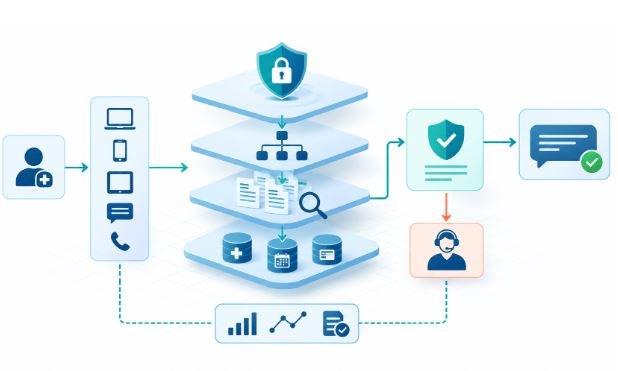
A production healthcare chatbot is not just an LLM behind a chat window. It is a layered system that retrieves approved knowledge, calls integrated systems through controlled interfaces, enforces guardrails, escalates to humans, and logs every step for audit. The model generates the language, and the surrounding architecture determines whether that language is safe and correct.
The core layers
- Channel layer. Web widget, patient portal, mobile app, SMS, voice, or messaging apps. Each channel has its own identity verification and formatting constraints.
- Identity and session layer. Authenticates the user, determines their role (patient, caregiver, clinician, billing staff), and scopes what data they may access.
- Orchestration layer. Manages conversation state, classifies intent, decides whether to retrieve knowledge, call a tool, ask a clarifying question, or escalate. Frameworks such as LangChain and LangGraph are often used here, but the framework is an implementation detail.
- Retrieval layer. Searches approved content such as protocols, policies, formularies, and patient education materials, then passes relevant passages to the model.
- Tool and integration layer. Typed, validated interfaces to the EHR, scheduling, billing, and CRM systems.
- Guardrail layer. Detects emergencies, blocks out-of-scope requests (such as diagnosis), enforces citation rules, and applies confidence thresholds.
- Escalation layer. Hands off to a nurse line, front desk, or billing specialist with the conversation context attached.
- Observability layer. Traces each conversation: inputs, retrieved passages, tool calls, outputs, latency, and cost, with sensitive fields redacted in logs where appropriate.
RAG basics for clinical and policy knowledge assistants
Retrieval-augmented generation (RAG) is the standard pattern for grounding chatbot answers in your own content. Instead of relying on what the model learned during training, the system looks up relevant passages first and then generates an answer from them.
Here is how the pipeline works:
- Parsing. Source documents such as PDFs, intranet pages, and policy manuals are converted to text while preserving tables and headings. A flattened dosage table, for example, can separate a value from what it describes.
- Chunking. Documents are split into coherent sections, ideally along their natural structure rather than at arbitrary lengths.
- Embeddings. Each chunk is converted into a numeric vector that represents its meaning, so semantically similar text sits close together.
- Vector database. The vectors are stored in a database built for similarity search, such as Qdrant or PostgreSQL with a vector extension.
- Hybrid search. Semantic search finds meaning, while keyword search finds exact terms such as drug names, procedure codes, and plan identifiers. Healthcare content usually needs both.
- Reranking. A second model reorders candidate passages so the passage that actually answers the question reaches the LLM.
- Generation. The LLM writes the answer using only the retrieved passages and cites them.
A production RAG system also needs freshness pipelines so that a superseded protocol stops appearing in answers once a new version is published.
Grounding, citations, and abstention
Grounding means every factual statement in an answer traces back to an approved source. In practice, this requires three design decisions:
- Citations are enforced, not optional. If the model makes a claim it cannot cite, the answer is blocked or rewritten. Users and reviewers can open the source to verify it.
- Abstention is a correct behavior. When retrieval returns nothing relevant, or confidence falls below a tuned threshold, the chatbot should say it does not know and route the user to a person. A confident guess is worse than an honest handoff.
- Scope is explicit. The system prompt and guardrails define what the assistant must never do, such as diagnose, adjust medication doses, or interpret lab results for patients.
Evaluation before go-live
Build an evaluation set from real questions before tuning anything. Include easy questions, ambiguous ones, out-of-scope requests, and questions that should trigger abstention or emergency escalation. Score retrieval quality separately from answer quality. A fluent answer built on the wrong passage is a retrieval failure, and you cannot fix it by rewriting prompts. Run the full set before every change to chunking, models, or prompts so improvements in one area do not quietly break another.
EHR and FHIR integration
HL7 FHIR (Fast Healthcare Interoperability Resources) is the API standard most modern EHRs expose. It represents clinical and administrative data as resources such as Patient, Appointment, Slot, Coverage, and MedicationRequest. A FHIR-ready chatbot reads and writes these resources through authorized API calls instead of scraping screens or using custom database queries.
Integration design principles that matter in healthcare:
- Least-privilege access. A scheduling chatbot needs Slot and Appointment access, not the full clinical record.
- Permissions enforced outside the model. Access limits live in the API and identity layer. Prompt instructions are never the security boundary, because untrusted input can override them.
- Validated writes. Every write is schema-checked and logged, and consequential writes require confirmation from the user or staff.
- Graceful degradation. If the EHR API is slow or unavailable, the chatbot routes the request to a queue rather than failing silently.
Escalation design
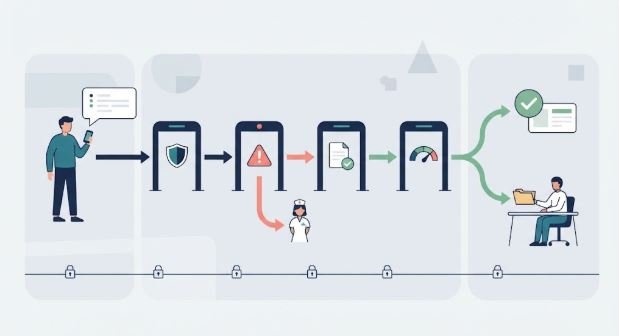
Escalation is a core feature, not a fallback. Define triggers explicitly:
- Emergency language or red-flag symptoms route immediately to emergency instructions and a human.
- Low retrieval confidence or repeated clarifying questions route to staff.
- Frustration, complaints, or requests for a person are honored without friction.
- Any request outside the defined scope is declined politely with a clear next step.
The handoff should include the conversation summary and collected data, so the patient does not have to repeat themselves.
Privacy, Security, and Risks of AI Chatbots in Healthcare
Healthcare chatbots handle protected health information, influence patient decisions, and operate under regulatory frameworks. As a result, privacy, security, and clinical safety need to be designed into the architecture from the start. The biggest risks are not exotic: confident wrong answers, unclear liability boundaries, weak access controls, and rollouts that disrupt existing workflows.
Mapping HIPAA safeguards to chatbot design
In the United States, the HIPAA Security Rule requires covered entities (health plans, health care clearinghouses, and providers that transmit health information electronically) and their business associates to implement administrative, physical, and technical safeguards for electronic protected health information (ePHI).1 For a chatbot, these safeguards translate into concrete engineering work:
- Risk analysis. The rule requires an accurate and thorough assessment of risks to ePHI.1 A new chatbot introduces new risks, including conversation logs, model provider data flows, and prompt injection. Each needs to be assessed.
- Access control and authentication. Only authorized people should access ePHI, and their identity must be verified.1 Patient-facing chatbots need identity verification before revealing any personal information.
- Audit controls. Systems must record and examine activity involving ePHI.1 Conversation traces and tool-call logs serve this purpose, but they also contain PHI, so they need their own access controls and retention policy.
- Transmission security and integrity. Data in transit must be protected, and ePHI must not be improperly altered.1
- Business associate agreements. Before a vendor creates, receives, maintains, or transmits ePHI on your behalf, a business associate agreement must be in place.1 That includes LLM API providers and hosting vendors in the data path.
Compliance is a property of your organization's program, not of a single tool. A vendor can design HIPAA-oriented controls, but your compliance team and counsel own the final sign-off.
Know where the regulatory boundary sits
Some software that supports clinical decisions is regulated as a medical device. The FDA's guidance on clinical decision support software explains that the 21st Century Cures Act excluded certain decision support software functions from the device definition. It also clarifies that FDA's digital health policies continue to apply to software functions that do meet the device definition, including those intended for use by patients or caregivers.2
The practical takeaway: a chatbot that schedules appointments sits in a very different category from one that tells patients what condition they likely have. Involve regulatory counsel early whenever a chatbot's output could influence diagnosis or treatment.
Limitations and failure modes to plan for
- Hallucinations. LLMs can generate plausible but false statements. RAG reduces this risk but does not eliminate it, especially when retrieval surfaces a similar-looking but wrong passage.
- Ambiguous symptoms. Patients describe symptoms imprecisely, and the same words can signal very different urgency. Chatbots should gather information and route conservatively, not reassure.
- Bias. Models and training data can perform unevenly across languages, literacy levels, and demographic groups. Test across your actual patient population, not a generic benchmark.
- Security threats. Prompt injection, data leakage through logs, and over-permissioned integrations are real attack paths. Treat all user input and retrieved documents as untrusted data.
- Liability boundaries. If a patient acts on chatbot guidance and is harmed, accountability questions follow. Clear scope, disclaimers, logging, and escalation reduce exposure but do not remove it.
- Patient trust. One confidently wrong answer can undo months of adoption. Transparency about being an AI system and easy access to a human both build trust.
- Workflow disruption. A chatbot that books into the wrong templates or floods staff with low-quality escalations creates more work than it saves.
Chatbots should not replace clinicians for diagnosis, treatment decisions, or other high-risk judgments. Their role is to prepare, route, inform, and reduce administrative load.
Human-in-the-loop design
Human oversight should be designed per action, not added as an afterthought:
- Review queues for low-confidence answers and flagged conversations.
- Approval gates before any write to a clinical record or any outbound message with clinical content.
- Sampling audits, where clinicians regularly review a sample of conversations against the evaluation rubric.
- Feedback loops so reviewer corrections become new evaluation cases.
Healthcare Chatbot Development Roadmap and Cost Drivers
A safe healthcare chatbot rollout starts with one narrow, low-risk workflow, proves reliability on real conversations, and expands only after the first use case earns trust. The biggest cost drivers are integrations, compliance requirements, and evaluation depth, not the model itself.
An eight-step implementation process
- Pick one workflow with clear value and low clinical risk. Appointment rescheduling, intake forms, or benefits questions are strong first candidates. Define what success means, such as fewer calls for a specific request type or faster intake completion.
- Map the current process end to end. Document who handles the request today, which systems they touch, and where judgment is required. This often reveals that part of the workflow should be simple automation instead of AI.
- Define scope, red flags, and escalation paths. Write down what the chatbot must never do, which phrases trigger emergency routing, and who receives each type of handoff.
- Prepare and approve the knowledge base. Gather current, approved documents and assign content owners. Retire outdated versions before ingestion, not after.
- Build the evaluation set first. Collect real questions, including edge cases and out-of-scope requests, with expected answers and sources reviewed by clinical or operations staff.
- Build the retrieval, integration, and guardrail layers. Use least-privilege API access, enforced citations, confidence thresholds, and complete tracing. Complete the security risk analysis and vendor agreements in parallel.
- Run a shadow or limited pilot. Operate alongside the existing process with a small user group. Compare outputs, review escalations, and tune thresholds on real data.
- Launch, monitor, and expand deliberately. Track answer quality, escalation rate, abstention rate, latency, and cost. Add new workflows only after the first is stable, reusing the integration and security layers you already built.
What drives healthcare chatbot development cost
There is no meaningful fixed price for a healthcare chatbot, because scope varies widely. These factors move the estimate most:
- Number and type of integrations. A website FAQ assistant is far simpler than a chatbot that reads from and writes to the EHR, scheduling, and billing systems.
- Answer-only vs action-taking. Writes to clinical or financial systems require validation, approvals, and audit logic.
- Knowledge base complexity. Volume, document formats, tables, and the number of content owners all affect parsing and evaluation effort.
- Compliance and data residency. Requirements for private cloud, on-premises hosting, or self-hosted models constrain architecture choices and add operational overhead.
- Channels and languages. Each channel and supported language adds testing and formatting work.
- Evaluation and monitoring depth. A rigorous test set and production tracing cost more upfront but prevent expensive failures later.
- Ongoing model usage. Per-conversation model costs scale with volume and context length, so routing simple requests to smaller models and keeping context tight matters at scale.
Common rollout mistakes
- Launching a general "ask me anything" health assistant instead of a scoped workflow.
- Measuring containment rate alone, which rewards the chatbot for not escalating even when it should.
- Skipping staff training, so escalations land in queues nobody owns.
- Treating the knowledge base as a one-time upload rather than living content with owners and review dates.
For organizations planning broader programs across clinical knowledge, intake, and revenue cycle work, our overview of healthcare AI development with privacy controls designed in explains how these components fit together.
The Future of Chatbots in Healthcare
The future of chatbots in healthcare is less about smarter conversation and more about safer action. Chatbots are evolving into governed assistants that connect to clinical and administrative systems, operate with explicit human checkpoints, and are continuously evaluated. Organizations that invest now in data quality, integration, and oversight will be best positioned to adopt these capabilities.
Directions worth tracking:
- From answering to acting. More chatbots will hand off to workflow agents that complete bookings, eligibility checks, and prior authorization preparation, with approval gates on consequential steps.
- Interoperability as a baseline. As FHIR APIs become standard across EHR vendors, integration will become more predictable, and the differentiator will shift to permission design and data quality.
- Voice and multimodal interfaces. Phone-based assistants and image-aware intake (for example, photographing an insurance card) will expand access for patients who struggle with text interfaces.
- Evaluation and observability as standard practice. Continuous testing, tracing, and drift monitoring will become an expectation in procurement, not a differentiator.
- Private and self-hosted models. Data residency and privacy requirements will push more organizations toward models deployed inside their own infrastructure for sensitive workloads.
- Evolving regulation. Expect continued regulatory attention to AI in clinical contexts. Teams should design for documentation, auditability, and clear intended-use boundaries now rather than retrofitting later.
FAQs
Are AI chatbots in healthcare HIPAA compliant?
A chatbot by itself is not HIPAA compliant or non-compliant. Compliance depends on how the system is built, hosted, and governed, and on the covered entity's overall program. When a chatbot handles ePHI, it needs safeguards such as access controls, authentication, audit logging, transmission security, a documented risk analysis, and business associate agreements with every vendor in the data path, including model providers.1
Can a healthcare chatbot diagnose patients?
A chatbot should not be positioned as a diagnostic tool without clinical validation, regulatory review, and clinician oversight. Symptom intake chatbots can collect information and route patients to the right level of care. Diagnostic and treatment decisions should remain with clinicians, and software functions that influence those decisions may fall under FDA device oversight.2
How do healthcare chatbots connect to EHR systems?
Most modern integrations use HL7 FHIR APIs, which expose resources such as patients, appointments, coverage, and medications through standardized endpoints. The chatbot calls these APIs under scoped credentials, so it can only reach the data its workflow requires. Every read and write should be logged, and writes that affect records should be validated and confirmed.
Should we buy an off-the-shelf healthcare chatbot or build a custom one?
Off-the-shelf platforms work well for standard use cases, such as FAQs or basic scheduling, when they integrate with your existing systems. Custom development makes sense when the chatbot must be grounded in your own protocols and policies, integrate deeply with internal systems, or meet specific hosting and data residency requirements. Many organizations start with a platform for simple needs and build custom components where their workflows are unique.
How do you measure whether a healthcare chatbot is working?
Measure accuracy against an evaluation set of real questions, with retrieval quality scored separately from answer quality. In production, track escalation rate, correct abstention, resolution rate for in-scope requests, user feedback, latency, and cost per conversation. Clinician review of sampled conversations adds a quality signal that automated metrics miss.
Conclusion
AI chatbots in healthcare deliver real value when they are scoped narrowly, grounded in approved content, connected to systems through controlled permissions, and backed by clear escalation to people. The model matters, but reliability comes from the architecture and governance around it.
If you already have a healthcare chatbot, RAG assistant, or AI agent in a pilot or in production and are not confident in its answers, book EnDevSols' free AI Reliability Check. In a 30-minute session, engineers review output quality, hallucination risk, latency, cost, and guardrails, then send a written audit within 24 hours that shows what to fix first, with no obligation to hire EnDevSols for the work.
SOURCES
External authoritative sources cited in the article:
- U.S. Food and Drug Administration, "Clinical Decision Support Software: Guidance for Industry and Food and Drug Administration Staff"
https://www.fda.gov/regulatory-information/search-fda-guidance-documents/clinical-decision-support-software
Used for: the 21st Century Cures Act exclusion of certain CDS software functions from the device definition, and the continued application of FDA digital health policies to device software functions, including those intended for patients or caregivers. - U.S. Department of Health and Human Services, "Summary of the HIPAA Security Rule"
https://www.hhs.gov/hipaa/for-professionals/security/laws-regulations/index.html
Used for: covered entities and business associates; administrative, physical, and technical safeguards; risk analysis; access control; audit controls; integrity; authentication; transmission security; and business associate agreements.
EnDevSols pages reviewed to verify company claims (internal, not cited as external evidence):
- https://endevsols.com/services/custom-business-chatbot
- https://endevsols.com/industries/healthcare
- https://endevsols.com/services/ai-agents-automation
- https://endevsols.com/services/rag-systems
- https://endevsols.com/ai-reliability-check
Footnotes
- U.S. Department of Health and Human Services, "Summary of the HIPAA Security Rule." https://www.hhs.gov/hipaa/for-professionals/security/laws-regulations/index.html
- U.S. Food and Drug Administration, "Clinical Decision Support Software: Guidance for Industry and Food and Drug Administration Staff." https://www.fda.gov/regulatory-information/search-fda-guidance-documents/clinical-decision-support-software