
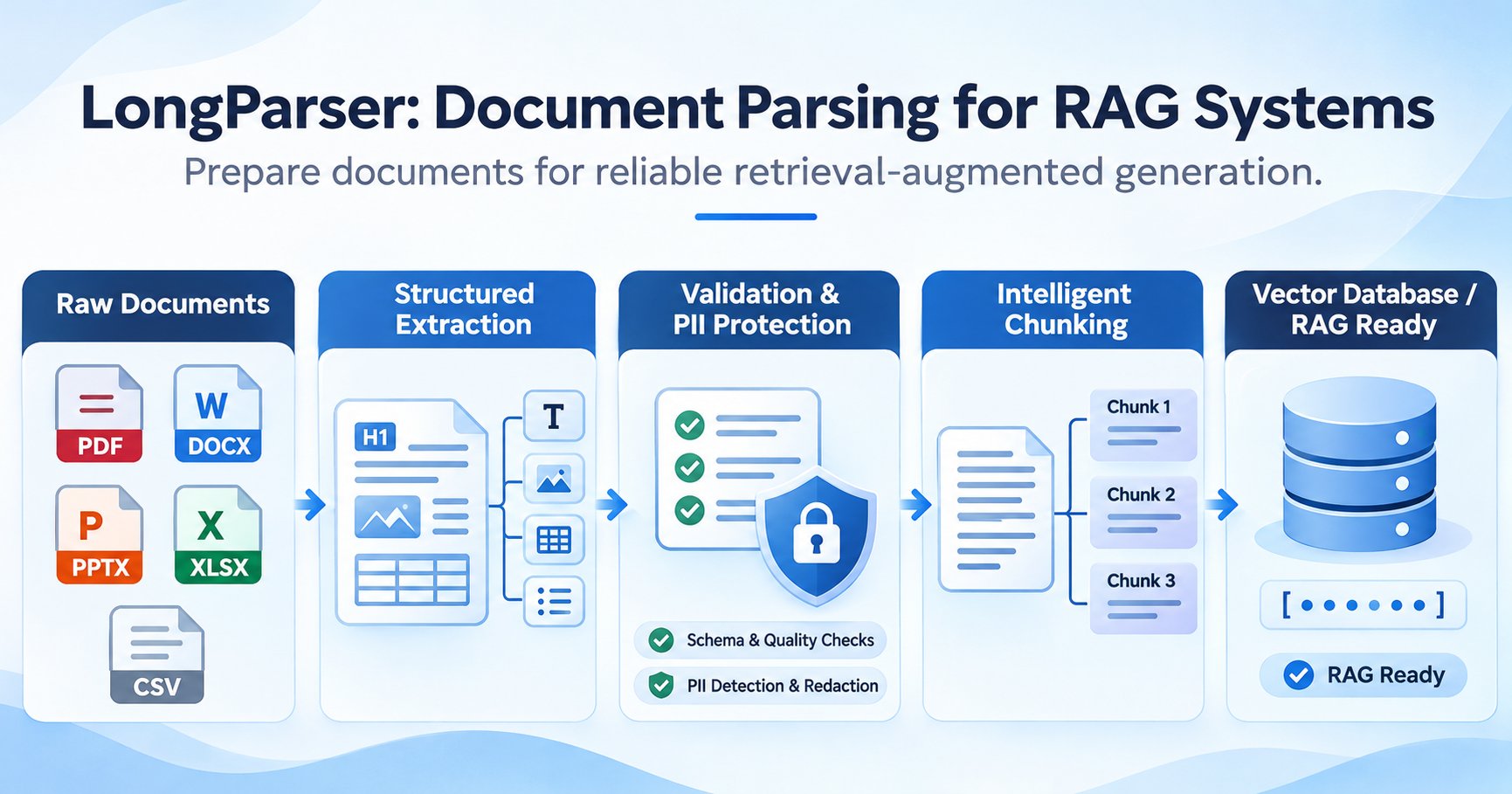
Document parsing for RAG is the foundation of reliable retrieval-augmented generation systems. Before an AI assistant can retrieve relevant information or generate accurate answers, documents must be extracted, structured, validated, and divided into meaningful chunks.
In production environments, this process is rarely straightforward. PDFs may contain complex tables, scanned pages, and inconsistent layouts. Word documents include nested headings, while spreadsheets contain structured data that can lose its meaning during basic text extraction.
LongParser is EnDevSols' open-source document intelligence toolkit designed to transform raw files into structured, AI-ready knowledge. It combines document extraction, intelligent chunking, quality validation, PII redaction, human-in-the-loop review, and vector database integrations.
Rather than treating document ingestion as a simple text-extraction task, LongParser provides a configurable processing pipeline for enterprise knowledge assistants, document intelligence applications, and production RAG systems.
This guide explores LongParser's architecture, supported formats, practical Python examples, REST API, privacy controls, intelligent chunking, and conversational retrieval capabilities.
Why Document Parsing Matters for Production RAG
A RAG system depends on the quality of the information stored in its knowledge base. Even a powerful language model cannot reliably answer questions when source documents have been incorrectly extracted or poorly structured.
A typical RAG workflow follows this sequence:
Documents → Parsing → Chunking → Embeddings → Vector Database → Retrieval → LLM Answer
Consider a financial report containing a table of annual revenue figures. If a basic PDF extractor separates numerical values from their column headings, the resulting text may be misleading. A vector database can retrieve that text correctly while the AI assistant still produces an inaccurate answer.
Common Document Ingestion Challenges
| Problem | What goes wrong | Impact on RAG |
|---|---|---|
| Incorrect extraction | Content is missing or reordered | Incomplete evidence |
| Flattened tables | Values lose their column relationships | Incorrect answers |
| Poor chunk boundaries | Related information is separated | Weak retrieval |
| Missing structure | Headings and context are lost | Reduced answer grounding |
| Scanned documents | Text requires OCR | Missing searchable content |
| Sensitive information | Personal data enters the knowledge base | Privacy risks |
These problems demonstrate why document ingestion requires structured processing, validation, and quality controls.
LongParser addresses this early stage of the RAG lifecycle, helping developers prepare more reliable information before it reaches retrieval and generation components.
LongParser Architecture: From Documents to AI-Ready Knowledge
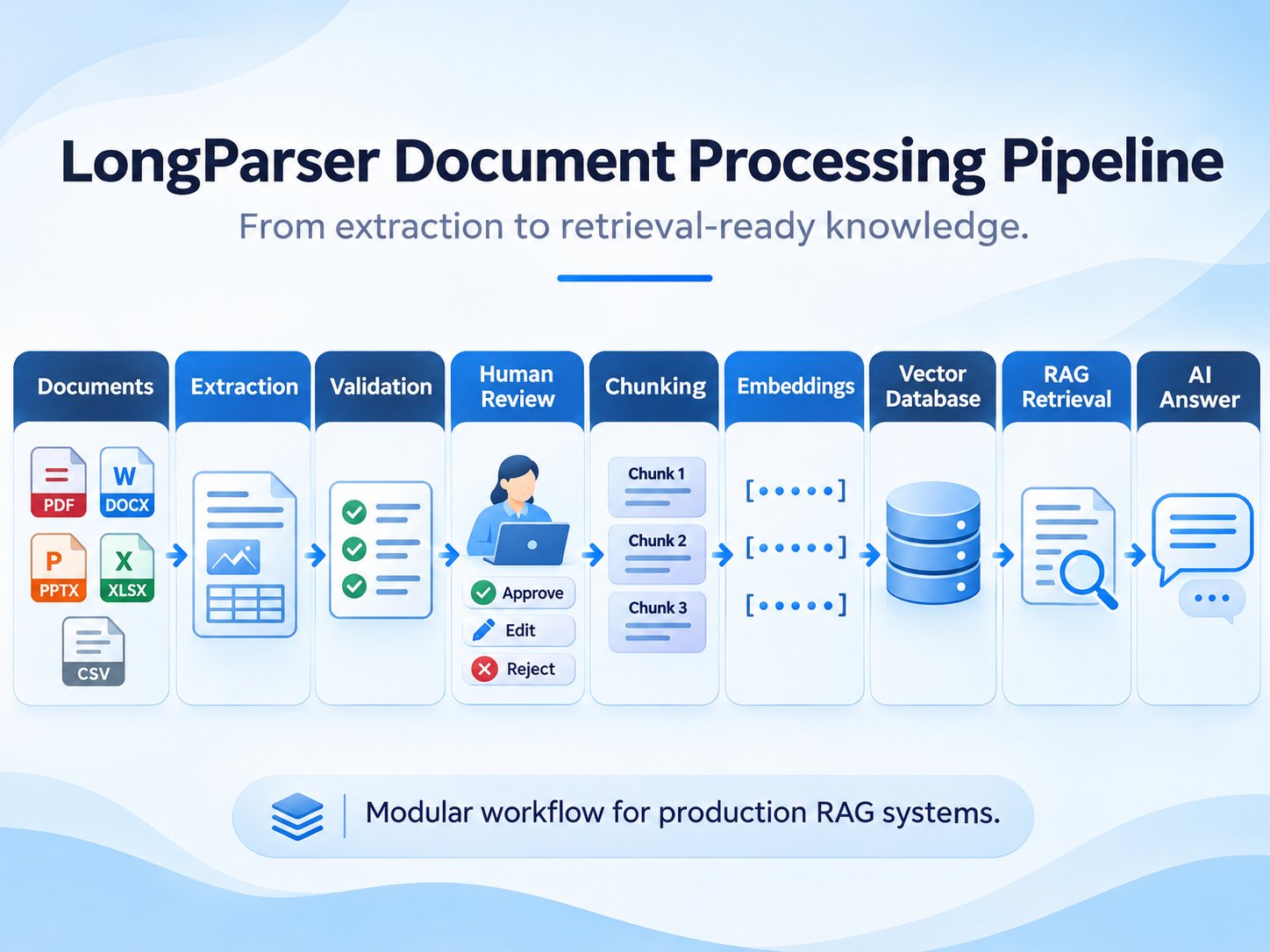
LongParser uses a modular document-processing architecture that separates extraction, validation, review, chunking, and indexing.
The main workflow is:
Documents → Extraction → Validation → Human Review → Chunking → Embeddings → Vector Indexing
Once documents are indexed, an optional RAG chat engine can retrieve relevant knowledge and generate responses.
Core Processing Components
1. Document Extraction
LongParser extracts structured content from supported documents while aiming to preserve headings, tables, equations, and page references.
2. Quality Validation
Extracted content undergoes quality assessment to help identify malformed text, incomplete extraction, and other issues that may affect retrieval.
3. PII Protection
Sensitive information can be detected and redacted using a combination of pattern matching and named entity recognition.
4. Human-in-the-Loop Review
Authorized reviewers can approve, edit, or reject extracted blocks and chunks before indexing.
5. Intelligent Chunking
LongParser's HybridChunker considers token budgets, heading hierarchy, table boundaries, and optional semantic relationships.
6. Embedding and Indexing
Approved chunks can be embedded using supported providers and stored in Chroma, FAISS, or Qdrant.
Architecture Summary
| Component | Responsibility |
|---|---|
| Document extractors | Convert files into structured content |
| Quality validation | Identify problematic extraction |
| PII redaction | Detect and mask sensitive information |
| HITL review | Approve or correct extracted content |
| HybridChunker | Create retrieval-ready chunks |
| Embedding engine | Convert content into vectors |
| Vector store | Enable semantic retrieval |
| Chat engine | Support document-based conversations |
This modular approach allows developers to use LongParser as a standalone document-processing component or integrate it into a larger RAG application.
Supported Document Formats and Extraction Backends
LongParser supports several common file formats used in enterprise knowledge systems.
| Format | Common use cases |
|---|---|
| Reports, research papers, technical manuals | |
| DOCX | Policies, contracts, documentation |
| PPTX | Presentations and training materials |
| XLSX | Financial reports and structured spreadsheets |
| CSV | Tabular datasets and operational records |
Extraction Backends
LongParser uses Docling as its default extraction backend, with optional support for PyMuPDF and Marker.
- Docling: Structured extraction for documents containing complex layouts, headings, and tables.
- PyMuPDF: An alternative backend for PDF text and document processing.
- Marker: An additional extraction option for document-processing workflows.
LongParser also includes capabilities for cross-referencing figures and charts, helping preserve relationships between document content and referenced elements.
The appropriate extraction strategy depends on document complexity, layout characteristics, processing speed, and required output quality.
For production applications, extraction results should be evaluated using representative documents rather than relying on processing speed alone.
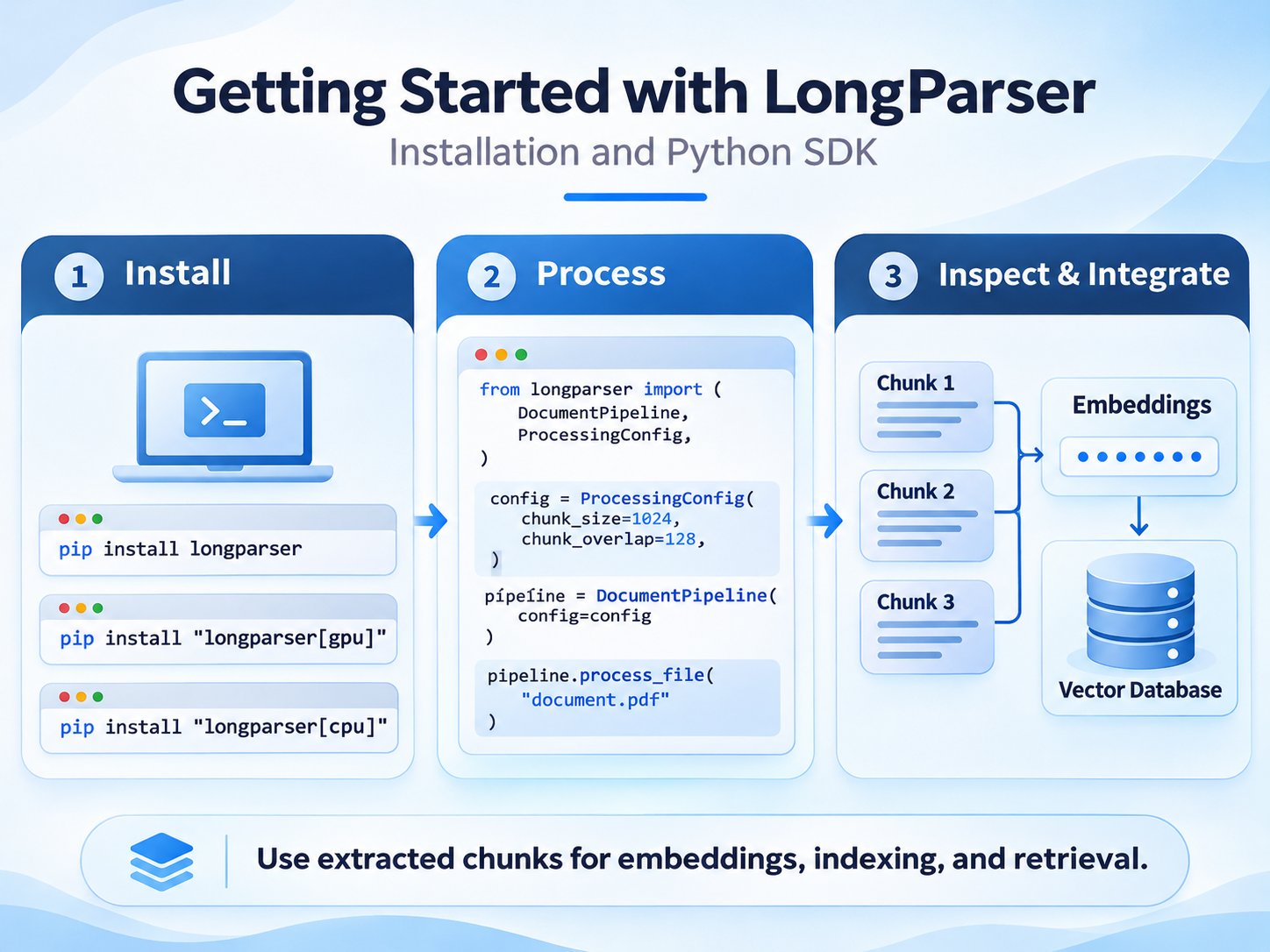
Getting Started with LongParser: Python SDK
LongParser provides a Python SDK that developers can integrate into existing applications without requiring a separate API server.
Installation
Install the core SDK:
pip install longparserFor a broader installation that includes server functionality, embeddings, vector databases, and optional integrations:
pip install "longparser[gpu]"A CPU-focused bundle is also available:
pip install "longparser[cpu]"The CPU and GPU installations have different dependency requirements. Developers should select the appropriate package configuration for their environment.
Process Your First Document
LongParser exposes a
DocumentPipeline interface for extracting and preparing documents.from longparser import DocumentPipeline, ProcessingConfig
pipeline = DocumentPipeline(ProcessingConfig())
result = pipeline.process_file("document.pdf")
print(f"Pages: {result.document.metadata.total_pages}")
print(f"Chunks: {len(result.chunks)}")
if result.chunks:
print(result.chunks[0].text)The main components are:
DocumentPipeline: Runs the document-processing workflow.ProcessingConfig: Defines processing configuration.process_file(): Processes the supplied document.result.document: Contains extracted document information.result.chunks: Contains chunks prepared for downstream processing.
Inspecting Extracted Chunks
Before indexing documents, developers should inspect the generated chunks.
for index, chunk in enumerate(result.chunks):
    print(f"Chunk {index + 1}")
    print(chunk.text)
    print("-" * 40)
Chunk inspection can reveal incomplete content, broken table structures, missing context, and poor boundaries.
These issues should be corrected before embedding and indexing important documents.
Intelligent Chunking Strategies in LongParser
Accurate extraction alone is not enough for reliable RAG. The extracted content must also be divided into meaningful units that retrieval systems can search effectively.
Traditional fixed-size splitting can separate related sentences, headings, and tables.
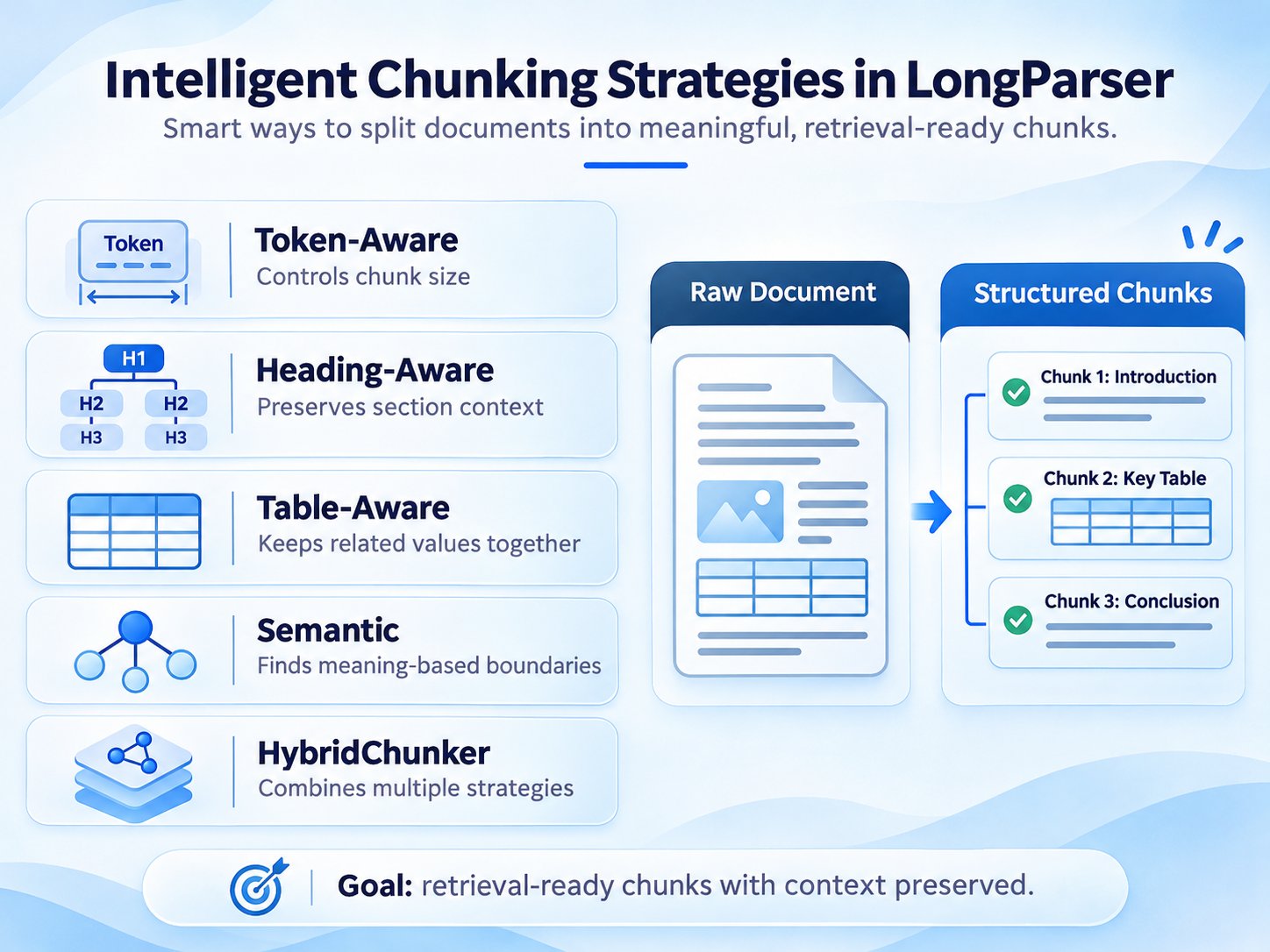
LongParser uses a HybridChunker that considers document structure alongside chunk-size constraints.
Token-Aware Chunking
Token-aware chunking controls chunk sizes according to token budgets.
This helps keep content within embedding-model limits while maintaining sufficient context for retrieval.
Heading-Aware Chunking
Technical documents often contain hierarchical sections.
LongParser considers heading relationships when constructing chunks, helping distinguish information belonging to different sections.
For example, content under "Security Requirements" should retain enough context to distinguish it from similar text under "Performance Requirements."
Table-Aware Chunking
Tables depend on relationships between rows, columns, and values.
LongParser considers table boundaries to reduce the likelihood of separating related tabular information during chunking.
This is particularly useful for financial documents, technical specifications, and research reports.
Semantic Chunking
LongParser supports optional embedding-based semantic chunking using the
all-MiniLM-L6-v2 model.Semantic chunking considers meaning-based relationships between text segments rather than relying exclusively on size or formatting.
This can help identify natural topic boundaries, although results still require evaluation against real retrieval tasks.
Chunking Strategy Comparison
| Strategy | Main purpose |
|---|---|
| Token-aware | Control chunk size |
| Heading-aware | Preserve section context |
| Table-aware | Maintain tabular relationships |
| Semantic | Identify meaning-based boundaries |
| Hybrid | Combine structural and size constraints |
The best chunking strategy depends on document type, retrieval requirements, and the embedding model.
Developers should evaluate chunk completeness, context preservation, table integrity, and actual retrieval performance before choosing a production configuration.
Quality Validation, PII Redaction, and Human Review
Production document ingestion requires more than generating chunks. Extracted information should be evaluated for quality and privacy risks before becoming searchable knowledge.
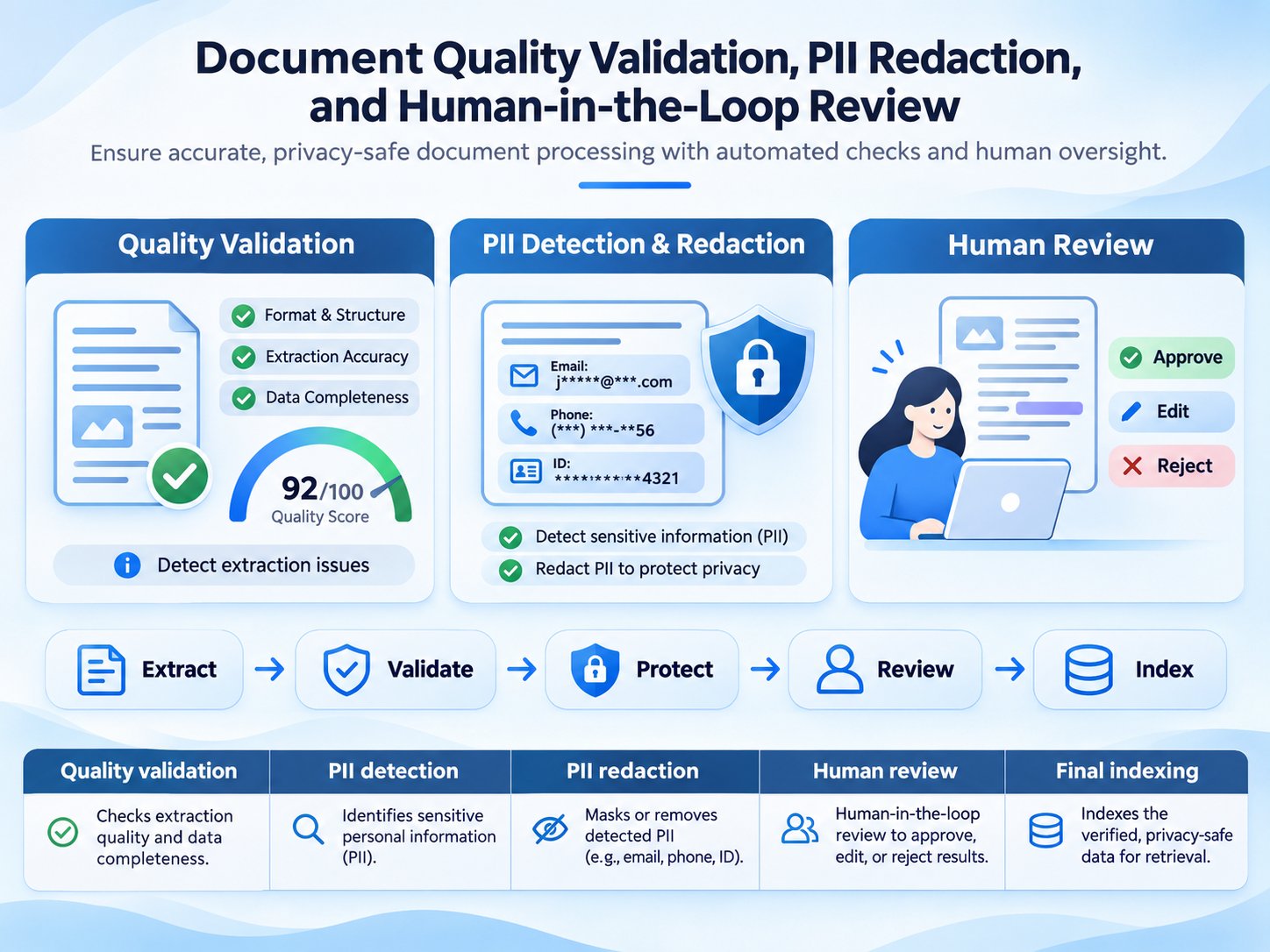
LongParser provides document-quality assessment, PII redaction, and human-in-the-loop review capabilities.
Document Quality Validation
LongParser includes heuristic scoring, dictionary-based checks, and fastText-based validation.
Its processing architecture also supports page-level confidence assessment and detection of potentially problematic content.
These mechanisms help identify extraction issues that may require further inspection.
Quality scores are useful signals, but they do not guarantee that every extracted fact is correct.
PII Detection and Redaction
Documents may contain sensitive information such as names, email addresses, phone numbers, and personal identifiers.
LongParser combines two approaches to PII detection:
- Regular expressions: Detect recognizable sensitive-data patterns.
- Named entity recognition: Use spaCy-based language analysis to identify additional personal information.
This hybrid strategy provides broader detection than fixed patterns alone.
However, automated redaction can miss sensitive information or incorrectly flag harmless content. Production deployments should test detection quality and apply appropriate access controls.
Human-in-the-Loop Review
LongParser supports review workflows where authorized users can approve, edit, or reject extracted blocks and chunks before indexing.
Its LangGraph-based integration uses
interrupt() and MongoDB checkpointing to support controlled review workflows.A typical process is:
Extraction → Validation → PII Protection → Human Review → Approval → Indexing
This additional control is valuable for financial reports, legal documents, internal policies, and other information where extraction errors may have significant consequences.
The objective is not to eliminate every error automatically, but to identify issues early and prevent unreviewed content from entering important retrieval workflows.
LongParser FastAPI Server and REST API
LongParser also provides a FastAPI-based REST API for applications that need centralized document-processing services.
The server architecture combines:
- FastAPI: HTTP endpoints and request handling.
- MongoDB: Document jobs and metadata.
- Redis: Queuing and rate limiting.
- ARQ workers: Asynchronous processing.
- Vector databases: Embedding storage and retrieval.
This architecture allows applications to upload documents, monitor processing jobs, manage review workflows, and prepare content for retrieval.
Starting the API Server
Install the server dependencies:
pip install "longparser[server]"From the cloned LongParser repository, create the environment file:
cp .env.example .envConfigure the required credentials and database settings.
Start MongoDB and Redis:
docker-compose up -d mongo redisLaunch the development server:
uv run uvicorn longparser.server.app:app --reload --port 8000Open the API documentation:
http://localhost:8000/docsThe
--reload option is intended for development rather than production.Upload a Document
Submit a document for processing:
curl -X POST http://localhost:8000/jobs \
  -H "X-API-Key: your-key" \
  -F "file=@document.pdf"
Check the processing job:
curl http://localhost:8000/jobs/{job_id} \
  -H "X-API-Key: your-key"
The API returns a job identifier that can be used to track processing.
Finalize and Embed Documents
After completing processing and any required review, finalize the job:
curl -X POST http://localhost:8000/jobs/{job_id}/finalize \
  -H "X-API-Key: your-key" \
  -H "Content-Type: application/json" \
  -d '{"finalize_policy": "approve_all_pending"}'
The
approve_all_pending policy approves pending content. It should only be used when automatic approval is appropriate.For sensitive documents, developers should apply an appropriate human-review policy.
After finalization, generate embeddings:
curl -X POST http://localhost:8000/jobs/{job_id}/embed \
  -H "X-API-Key: your-key" \
  -H "Content-Type: application/json" \
  -d '{
    "provider": "huggingface",
    "model": "BAAI/bge-base-en-v1.5",
    "vector_db": "chroma"
  }'
This prepares approved content for semantic retrieval.
Docker Deployment
LongParser includes Docker configuration for its API and supporting services.
From the repository:
docker-compose upThe API is available at:
http://localhost:8000Production deployments should additionally configure authentication, authorization, secret management, persistent storage, monitoring, worker capacity, and appropriate network security.
LongParser Integrations and RAG Chat
LongParser supports both external RAG frameworks and its own optional document-chat capabilities.
LangChain Integration
Developers can load processed documents into LangChain using
LongParserLoader.from longparser.integrations.langchain import LongParserLoader
loader = LongParserLoader("report.pdf")
docs = loader.load()The returned documents can be used in LangChain retrieval and processing workflows.
LlamaIndex Integration
LongParser also provides a reader integration for LlamaIndex.
from longparser.integrations.llamaindex import LongParserReader

reader = LongParserReader()

docs = reader.load_data("report.pdf")
This allows developers to use LongParser's document-processing functionality inside LlamaIndex applications.
Built-in RAG Chat Engine
LongParser includes a document-chat engine using LangChain Expression Language (LCEL).
The chat workflow combines retrieval, language model generation, conversation memory, and citation validation.
User Question → Conversation Context → Document Retrieval → LLM Generation → Citation Validation → Answer
The chat engine supports multiple language model providers, including OpenAI, Google Gemini, Groq, and OpenRouter.
Three-Layer Conversation Memory
LongParser uses three complementary memory layers:
| Memory layer | Purpose |
|---|---|
| Short-term turns | Maintain recent conversation history |
| Rolling summary | Condense older interactions |
| Long-term facts | Preserve useful information across conversations |
For example, a user might ask about a company's refund policy and then follow up with, "Does that apply to international customers?"
Conversation memory helps the assistant interpret follow-up questions in context rather than treating every message as an isolated request.
Creating a Chat Session
After processing and indexing a document, create a chat session:
curl -X POST http://localhost:8000/chat/sessions \
  -H "X-API-Key: your-key" \
  -H "Content-Type: application/json" \
  -d '{"job_id": "your-job-id"}'
Ask a question using the returned session identifier:
curl -X POST http://localhost:8000/chat \
  -H "X-API-Key: your-key" \
  -H "Content-Type: application/json" \
  -d '{
    "session_id": "your-session-id",
    "job_id": "your-job-id",
    "question": "What is the refund policy?"
  }'
The chat engine retrieves relevant document content and passes it to the configured language model.
Citation validation provides an additional reliability signal, but it does not guarantee that every generated statement is factually correct.
For more detailed evidence-based answer verification, LongParser can be combined with LongTracer.
Production Best Practices and Real-World Applications
LongParser provides the components needed to build document-processing workflows, but production reliability depends on how they are configured and operated.
Recommended Practices
1. Validate documents before indexing
Inspect extraction quality, document structure, and chunk completeness before adding content to the knowledge base.
2. Protect sensitive data
Apply appropriate PII redaction, storage permissions, retention policies, and access controls.
3. Use human review where necessary
Require manual approval for sensitive or high-impact documents rather than automatically accepting every extraction result.
4. Evaluate retrieval quality
Test whether generated chunks preserve sufficient context and whether relevant information is actually retrievable.
5. Monitor processing performance
Measure document-processing latency, worker resource usage, embedding costs, and background job failures.
Real-World Use Cases
| Application | How LongParser helps |
|---|---|
| Enterprise knowledge assistants | Prepare internal policies and documentation |
| Financial document analysis | Extract reports and structured tables |
| Legal document research | Process contracts and supporting documents |
| Research assistants | Prepare research papers for retrieval |
| Customer support chatbots | Index help documentation and policies |
| Technical documentation search | Preserve headings and contextual relationships |
LongParser is particularly useful when document quality, privacy, and structured retrieval are important.
Frequently Asked Questions About LongParser
What is LongParser?
LongParser is an open-source Python toolkit for extracting, validating, chunking, and preparing documents for retrieval-augmented generation applications.
Which document formats does LongParser support?
LongParser supports PDF, DOCX, PPTX, XLSX, and CSV files using its configurable extraction architecture.
Does LongParser support OCR and scanned documents?
LongParser provides document-processing backends and optional OCR capabilities. Extraction results depend on document characteristics, backend configuration, and the quality of the source material.
How does LongParser improve RAG retrieval quality?
LongParser combines structured extraction with token-aware, heading-aware, table-aware, and optional semantic chunking. This helps preserve useful context before embedding and retrieval.
Can LongParser protect sensitive information?
LongParser supports PII detection, redaction, and human-review workflows. These features should be combined with appropriate infrastructure security and data governance.
Can LongParser work with existing RAG frameworks?
Yes. LongParser provides a Python SDK, REST API, LangChain and LlamaIndex integrations, and an optional document-chat engine.
Is LongParser suitable for production applications?
LongParser includes document-processing, background-job, authentication, and deployment components. Production readiness depends on appropriate configuration, security testing, performance evaluation, and monitoring.
Get Started with LongParser
Reliable RAG systems begin with reliable document processing.
Poor extraction, missing document structure, and inappropriate chunk boundaries can reduce retrieval quality before an AI model generates its first answer.
LongParser addresses these challenges through structured extraction, intelligent chunking, quality validation, PII redaction, and human-in-the-loop review. Its Python SDK, FastAPI server, vector database integrations, and optional RAG chat engine provide developers with flexible tools for building document-aware applications.
Explore the LongParser GitHub repository for source code, installation instructions, configuration options, and development examples.
You can also explore the LongParser project page for an overview of the toolkit.
As part of the broader Long Suite ecosystem, LongParser focuses on preparing reliable knowledge for AI applications, while complementary tools can support answer verification, agent execution, and retrieval testing.
By combining structured document ingestion with appropriate validation, retrieval evaluation, and monitoring, developers can build more maintainable and reliable production RAG systems.